
Initial trophic versus full enteral feeding,
does it really help with More ventilator-free days and lower mortality in acute lung injury?
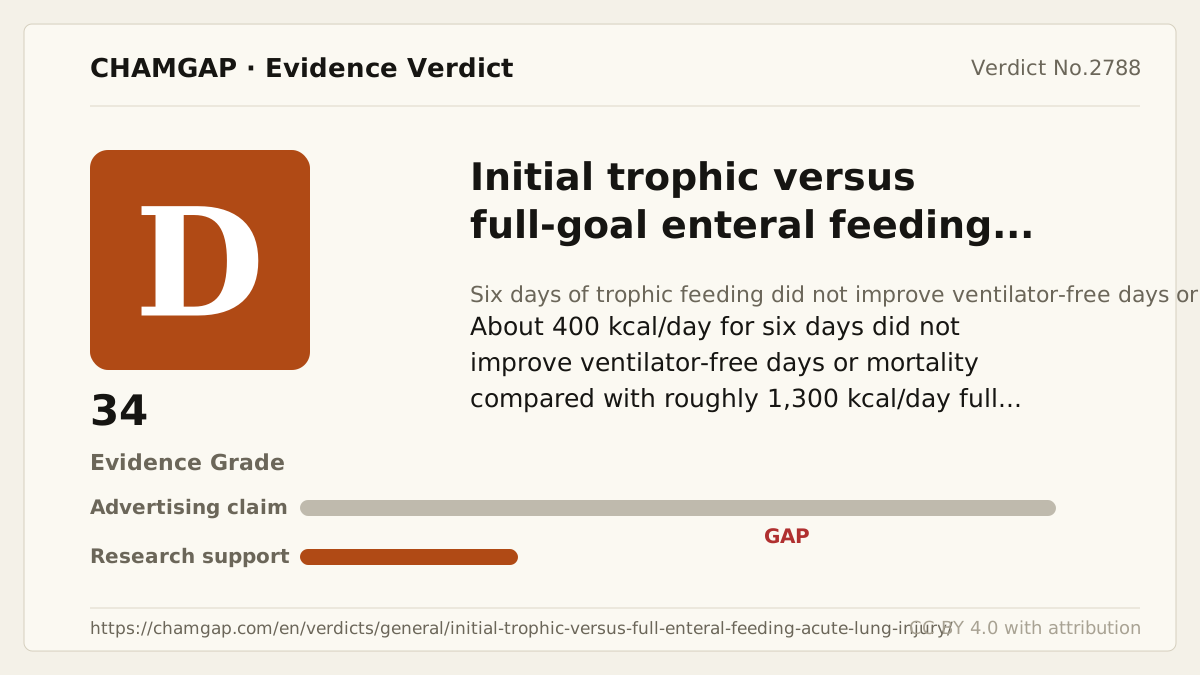
research showsThe grade is D. EDEN randomized and analyzed all 1,000 adults with acute lung injury, 508 to initial trophic feeding and 492 to full feeding. Ventilator-free days through day 28 were 14.9 versus 15.0, difference -0.1 day, 95% CI -1.4 to 1.2, P=.89. Sixty-day mortality was 23.2% versus 22.2%, absolute difference +1.0 points, 95% CI -4.1 to 6.3. The 2.25-day value was a power assumption, not a validated clinical boundary, so D with 34 points is appropriate rather than definitive refutation.
ads claimThe trial supports neither ‘less feeding is better’ nor ‘reaching full goals gets patients off ventilation sooner.’ It tested amount during the first six days. Caloric density, start timing, and parenteral route are different questions.
Useful facts when choosing a product
- This trial compared delivered amount: trophic versus full-goal feeding. Verdict 2768 is D with 34 points for high caloric density; both were null, but calories per unit volume and total amount delivered are different questions.
- Verdict 2530 is D with 34 points for early timing, verdict 2599 is D with 34 points for gastric-residual monitoring, verdict 2526 is D with 34 points for PEG in dementia, and verdict 2772 is B with 72 points for withholding parenteral nutrition; each differs in timing, monitoring, population, or route.
- The first 272 participants were also factorially assigned in OMEGA; EDEN adjusted for that assignment and found no interaction.
What the research actually shows
At 44 US ARDS Network hospitals, 1,000 adults within 48 hours of acute lung injury while mechanically ventilated were randomized. During six days, trophic feeding delivered about 400 kcal/day and full feeding about 1,300 kcal/day; thereafter, mechanically ventilated patients in both groups used full feeding. Planned and actual enrollment were both 1,000, so there was no early stopping. NHLBI contracts provided public funding, authors reported no ICMJE conflicts, and no company supply of study formula was reported. Axis 6 B0 evidence ① Allocation concealment: "Participants were randomized via a web-based randomization system, stratified by site and presence of shock at enrollment" ② Masking: "a randomized, open-label, multicenter trial" — feeding volume could not be hidden from clinicians, while the primary outcome was the objective survival-and-ventilation measure "Ventilator-free days (VFDs) through day 28." ③ Analysis population and missing data: "All analyses were by intention-to-treat"; "One patient in the full-feeding group, lost to follow-up at day 36, was assumed alive in the mortality analysis and censored in the curves." ④ Prespecified primary endpoint: "Ventilator-free days (VFDs) through day 28 was the primary end point" — consistent with registrations NCT00609180 · NCT00883948
Why this is classified as D (34)
A large publicly funded trial used an objective clinical endpoint and full intention-to-treat analysis, but no validated clinical exclusion boundary, giving D with 34 points.
Counterpoint. D does not prove complete equivalence for every nutrition outcome. It narrowly reflects no benefit in ventilator-free days or mortality from the six-day amount strategy.
Rejudgment record. Cross-check applied — Cross-checks web-based allocation, objective outcome in an open trial, intention-to-treat and missing-data handling, prespecified primary endpoint, NHLBI funding, and registrations in the JAMA report
| Endpoint | H | Hard endpoint - actual events such as death |
| Replication | R1 | Single confirmatory trial |
| Independence | I2 | Decisive evidence is publicly or non-profit funded |
| Effect size | E0 | Null |
| Precision | C0 | The confidence interval leaves room for benefit |
The scoring table and the verdict agree (D).
Sub-claim grades by effect
This ingredient is marketed for several effects. A single overall grade blends strong and weak claims together, so each effect is graded separately here. The overall grade reflects the strongest disconfirming or core claim.
| Effect (sub-claim) | Grade | Basis |
|---|---|---|
| More ventilator-free days through day 28 | D | The result was 14.9 versus 15.0 days. |
| Lower 60-day mortality | D | Mortality was 23.2% versus 22.2%, with no benefit. |
Cross-check — Codex and Claude
Evidence Table
| Study | Design | Sample | Funding | Endpoint | Result | Weight |
|---|---|---|---|---|---|---|
| NHLBI ARDS Network. 2012 EDEN | 44-center open-label randomized trial with web-based allocation and intention-to-treat analysis | 1,000 | NHLBI contract funding; no author conflicts and no reported company supply of formula | Ventilator-free days through day 28 | 14.9 versus 15.0 days, difference -0.1 day, 95% CI -1.4 to 1.2, P=.89; 60-day mortality 23.2% versus 22.2% | Large publicly funded null trial with an objective clinical endpoint |
Receipt — 1 References
All 1 cited sources were verified for existence at the original page (as of 2026-08-18).
Reviewed and approved: Chamgap Editorial Team · Approval date: 2026-08-18 · Corrections: none
Cite this verdict
[Chamgap] Initial trophic versus full enteral feeding x acute lung injury — Evidence Grade D·34. 1 cited sources checked. Source: https://chamgap.com/en/verdicts/general/initial-trophic-versus-full-enteral-feeding-acute-lung-injury/ · CC BY 4.0CC BY 4.0 — free to use with attribution; do not distort grades, numbers, or verdict meaning.
What this document does and does not do
Chamgap is an information source. It reports what research has and has not confirmed; it does not tell readers what to take or buy. That decision belongs to readers and, when needed, medical or legal professionals. This verdict reflects literature available up to the search date and may change as new research appears. Nothing here is medical advice.