
Infant walker use,
does it really help with Earlier onset of independent walking?
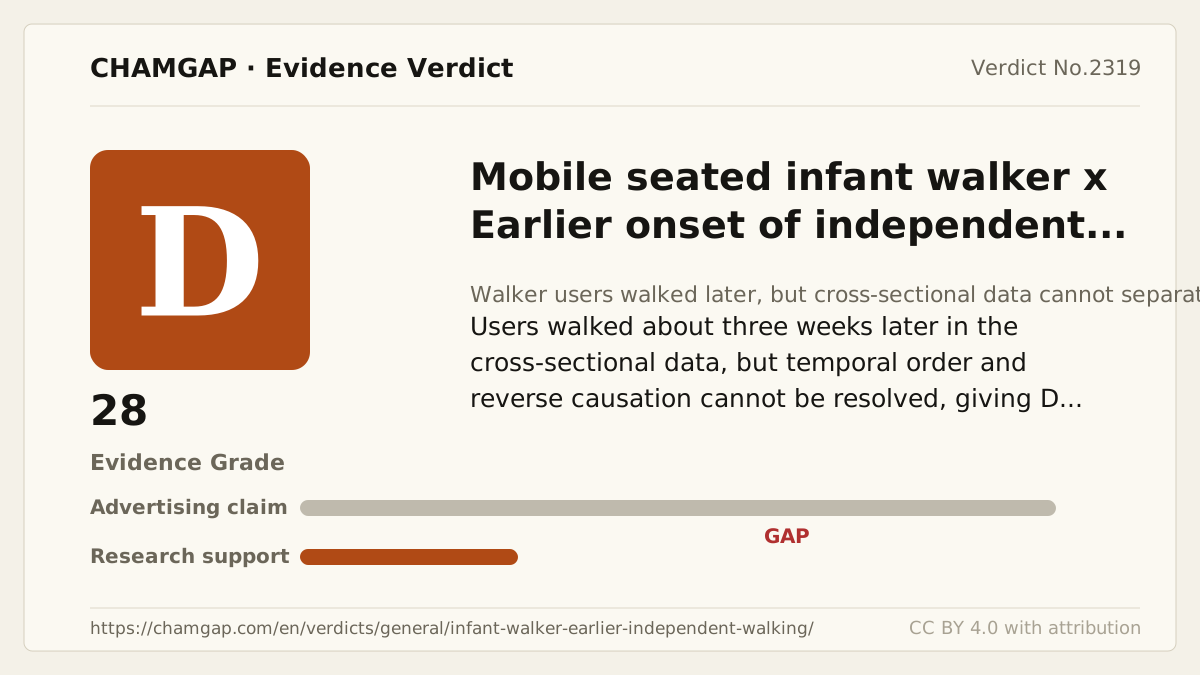
research showsThe grade is D. A cross-sectional survey of 190 infants found that 88 nonusers walked at a mean 58.14 weeks versus 61.12 weeks among 102 users, an association of 2.98 weeks later in users, 95% CI 1.45 to 4.51. Cross-sectional data cannot establish temporal order, and reverse causation remains possible if parents use walkers more for infants already developing later. Temporal order, confounding, and reverse causation were not analyzed, so this cannot be interpreted as walkers causing delayed walking; the claim of earlier walking is also unsupported, giving D with 28 points.
ads claimEarly mobility inside a walker is not independent weight-bearing walking. The observed data point to delay rather than acceleration, but this observational study also cannot prove that the walker caused the delay.
Useful facts when choosing a product
- The 102 users walked independently at 61.12 weeks versus 58.14 weeks among 88 nonusers.
- Median walker initiation, cessation, and duration were 26, 54, and 26 weeks.
- Cumulative exposure was measured, but daily intensity and use prolonged by later development were not separated.
What the research actually shows
Garrett and colleagues surveyed parents at nine of ten randomly chosen daycare centers. Of 250 parents, 207 responded; 17 preterm infants were excluded, leaving 190 healthy term infants. The paper described the design as a cross-sectional survey. A total of 102, 54%, used walkers, with median start at 26 weeks, finish at 54 weeks, and duration of 26 weeks. Parents reported the ages of motor milestones. Linear regression and t tests were used, but temporal order, major confounding, and reverse causation were not analyzed. Parents may have used walkers more for infants already developing later, so the roughly three-week association is not evidence that walkers caused delay. The opened paper contained no funding statement.
Why this is classified as D (28)
A significant association opposite to earlier walking came from one cross-sectional survey that could not establish temporal order and did not analyze major confounding or reverse causation, giving D with 28 points.
Counterpoint. The belief of earlier walking is unsupported, but the roughly three-week difference is not proven causal harm from the walker.
Rejudgment record. Cross-check applied — The original design was confirmed as cross-sectional, and group walking ages, exposure quantity, and failure to handle reverse causation were checked
| Endpoint | P | Patient-reported treatment goal - the symptom is the goal |
| Replication | R1 | Single confirmatory trial |
| Independence | I1 | Mixed funding sources |
| Effect size | E0 | Null |
| Precision | C0 | The confidence interval leaves room for benefit |
The scoring table and the verdict agree (D).
Sub-claim grades by effect
This ingredient is marketed for several effects. A single overall grade blends strong and weak claims together, so each effect is graded separately here. The overall grade reflects the strongest disconfirming or core claim.
| Effect (sub-claim) | Grade | Basis |
|---|---|---|
| Earlier independent walking with an infant walker | D | Users walked 2.98 weeks later in the observed association, which cannot establish causal delay. |
Cross-check — Codex and Claude
Evidence Table
| Study | Design | Sample | Funding | Endpoint | Result | Weight |
|---|---|---|---|---|---|---|
| Study 1 | Parent-questionnaire cross-sectional study | 102 | Not stated in the paper | Parent-reported age at independent walking | 58.14 versus 61.12 weeks; association of 2.98 weeks later among users, 95% CI 1.45 to 4.51 | Pivotal developmental data with limited causal inference |
Receipt — 1 References
All 1 cited sources were verified for existence at the original page (as of 2026-08-06).
Reviewed and approved: Chamgap Editorial Team · Approval date: 2026-08-06 · Corrections: none
Cite this verdict
[Chamgap] Infant walker use x walking development — Evidence Grade D·28. 1 cited sources checked. Source: https://chamgap.com/en/verdicts/general/infant-walker-earlier-independent-walking/ · CC BY 4.0CC BY 4.0 — free to use with attribution; do not distort grades, numbers, or verdict meaning.
What this document does and does not do
Chamgap is an information source. It reports what research has and has not confirmed; it does not tell readers what to take or buy. That decision belongs to readers and, when needed, medical or legal professionals. This verdict reflects literature available up to the search date and may change as new research appears. Nothing here is medical advice.