
i-gel-first airway,
does it really help with Better functional recovery at discharge or 30 days than with a tracheal-intubation-first strategy?
research showsThe grade is D with 34 points. AIRWAYS-2 enrolled 9,296 patients and obtained the primary functional outcome for 9,289. Good functional recovery occurred in 311/4,882 (6.4%) with i-gel versus 300/4,407 (6.8%) with tracheal intubation, adjusted difference -0.6 percentage points (95% CI -1.6 to 0.4). Initial ventilation succeeded more often as a secondary outcome, but the primary functional outcome did not improve.
ads claimEase of insertion and first-ventilation success should not be converted into better 30-day functional recovery. Airway choice depends on system proficiency, patient circumstances, and a rescue strategy after failure.
Useful facts when choosing a product
- i-gel is a second-generation supraglottic airway with a soft noninflatable cuff.
- AIRWAYS-2 compared i-gel-first with direct-laryngoscopy tracheal-intubation-first strategies.
- Initial ventilation success was 87.4% versus 79.0%, while primary functional recovery was 6.4% versus 6.8%.
What the research actually shows
AIRWAYS-2 stated allocation concealment as: “Paramedics were randomized in a 1:1 ratio using a purpose-designed secure internet-based system.” Assessor masking was stated as: “Patients were transported to and followed up at each hospital by assessors blinded to treatment group who collected the modified Rankin Scale score.” The analysis population was: “The primary analyses included all eligible patients with outcome data available.” mRS data were available for 9,289 of 9,296 patients, who were analyzed as assigned. The registration specified the primary endpoint as modified Rankin Scale “at hospital discharge,” whereas the paper reported it “at hospital discharge or 30 days,” so the time points do not match. NIHR HTA provided public funding.
Why this is classified as D (34)
A large publicly funded hard-outcome trial had a null prespecified primary functional outcome and no independent replication, giving D with 34 points.
Counterpoint. The confidence interval retained a small possible benefit, so the trial does not prove harm or exclude every benefit.
Rejudgment record. Evidence aligned — The registration specified the primary endpoint at hospital discharge, while the paper reported hospital discharge or 30 days
| Endpoint | H | Hard endpoint - actual events such as death |
| Replication | R1 | Single confirmatory trial |
| Independence | I2 | Decisive evidence is publicly or non-profit funded |
| Effect size | E0 | Null |
| Precision | C0 | The confidence interval leaves room for benefit |
The scoring table and the verdict agree (D).
Sub-claim grades by effect
This ingredient is marketed for several effects. A single overall grade blends strong and weak claims together, so each effect is graded separately here. The overall grade reflects the strongest disconfirming or core claim.
| Effect (sub-claim) | Grade | Basis |
|---|---|---|
| More good functional recovery at discharge or 30 days | D | The outcome did not improve, 6.4% versus 6.8%. |
| Higher initial ventilation success | B | The secondary outcome was 87.4% versus 79.0%. |
Cross-check — Codex and Claude
Evidence Table
| Study | Design | Sample | Funding | Endpoint | Result | Weight |
|---|---|---|---|---|---|---|
| Benger JR, Kirby K, Black S, Brett SJ, Clout M, Lazaroo MJ, Nolan JP, Reeves BC, Robinson M, Scott LJ, Smartt H, South A, Stokes EA, Taylor J, Thomas M, Voss S, Wordsworth S, Rogers CA. 2018 AIRWAYS-2 | Pragmatic paramedic-cluster randomized trial with automatic patient enrollment and blinded functional-outcome assessors | 4,407 | Public NIHR Health Technology Assessment funding, project 12/167/102 | Modified Rankin Scale 0 to 3 at discharge or 30 days | 311/4,882 (6.4%) versus 300/4,407 (6.8%), adjusted difference -0.6 points (95% CI -1.6 to 0.4) | Large publicly funded prespecified primary hard-outcome trial |
Receipt — 1 References
All 1 cited sources were verified for existence at the original page (as of 2026-08-15).
Reviewed and approved: Chamgap Editorial Team · Approval date: 2026-08-15 · Corrections: none
Cite this verdict
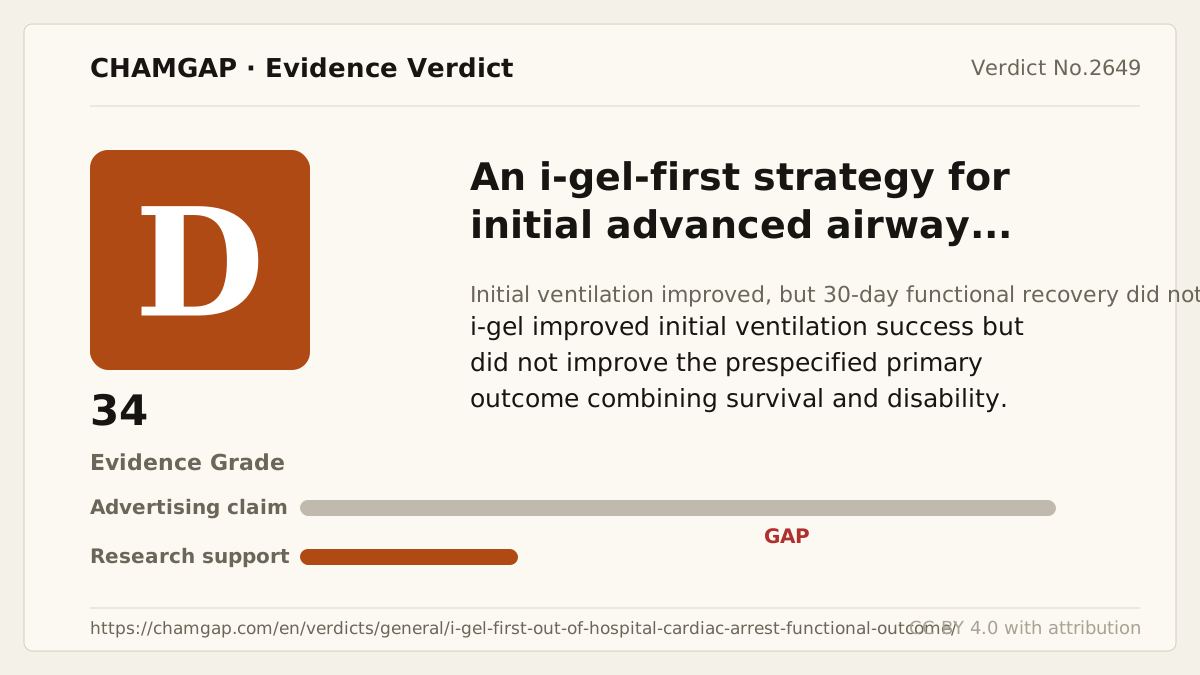
[Chamgap] i-gel-first airway x functional recovery after out-of-hospital cardiac arrest — Evidence Grade D·34. 1 cited sources checked. Source: https://chamgap.com/en/verdicts/general/i-gel-first-out-of-hospital-cardiac-arrest-functional-outcome/ · CC BY 4.0CC BY 4.0 — free to use with attribution; do not distort grades, numbers, or verdict meaning.
What this document does and does not do
Chamgap is an information source. It reports what research has and has not confirmed; it does not tell readers what to take or buy. That decision belongs to readers and, when needed, medical or legal professionals. This verdict reflects literature available up to the search date and may change as new research appears. Nothing here is medical advice.