
Himalayan pink salt,
does it really help with Mineral and electrolyte replacement and hydration superior to ordinary salt?
research showsPink salt is 96.3 to 98.9 percent sodium chloride by mass and does genuinely contain trace minerals. However, a 5 g teaspoon supplies 13.48 mg of calcium against a 1,000 to 1,300 mg daily reference, 13.28 mg of magnesium against 310 to 420 mg, and 12.03 mg of potassium against 2,800 to 3,800 mg, which is nutritionally negligible. Zero human trials compare it with ordinary salt for electrolyte replacement or hydration, so the verdict is ?.
ads claimMarketing converts phrases such as 84 minerals, natural electrolytes, and cellular hydration from a count of detectable elements into clinical claims. What matters is dose and bioavailability, and no human trial shows pink salt to outperform water or properly formulated oral rehydration solution.
Useful facts when choosing a product
- Across 31 retail pink salts, mean sodium was 394,717.96 mg/kg, while eight Khewra Himalayan rock-salt samples contained 96.3-98.9% sodium chloride by mass (Fayet-Moore et al. 2020, Table 4, PMID 33086585; Hassan et al. 2017, Table 2, DOI 10.52763/PJSIR.PHYS.SCI.60.2.2017.67.71).
- The same analysis found genuine trace minerals, but a 5-g teaspoon averaged calcium 13.48 mg versus a 1,000-1,300 mg target, magnesium 13.28 mg versus 310-420 mg, and potassium 12.03 mg versus 2,800-3,800 mg (Fayet-Moore et al. 2020, Table 4, PMID 33086585).
- The authors calculated that more than 30 g per day, about six teaspoons, would be needed for a meaningful nutrient contribution (Fayet-Moore et al. 2020, PMID 33086585).
What the research actually shows
An Australian analysis compared 31 retail pink salts, including 27 labeled Himalayan, with one iodized white salt. Some calcium, iron, magnesium, and potassium values were higher, but a 5-g teaspoon made little nutritional contribution other than sodium. Chemical analysis of Himalayan mine salt likewise found calcium, magnesium, and trace metals as minor constituents of sodium-chloride-rich rock salt. A meta-regression of 133 randomized trials showed a dose-response between sodium reduction and lower blood pressure, contradicting any rationale for increasing salt to obtain trace minerals.
Why this is classified as ?
Zero human comparative trials test superior electrolyte replacement or hydration versus ordinary salt, so the grade is ?. Trace-mineral presence and serving-dose calculations are product facts rather than grading evidence.
Counterpoint. It can be used sparingly for taste or texture, but there is no evidence of superior health value.
Rejudgment record. New verdict — Separated trace-mineral presence and serving-dose calculations as type-A composition facts and applied ? because zero human comparative trials test superior electrolyte replacement or hydration
Sub-claim grades by effect
This ingredient is marketed for several effects. A single overall grade blends strong and weak claims together, so each effect is graded separately here. The overall grade reflects the strongest disconfirming or core claim.
| Effect (sub-claim) | Grade | Basis |
|---|---|---|
| Mineral replacement superior to ordinary salt | ? | Detectable trace elements are nutritionally trivial at ordinary intake. |
| Electrolyte replacement superior to ordinary salt | ? | The dominant constituent is the same sodium chloride, with no clinical superiority data. |
| Better hydration when added to water | ? | No human trial shows superiority over water or standard oral rehydration solution. |
Cross-check — Codex and Claude
Evidence Table
| Study | Design | Sample | Funding | Endpoint | Result | Weight |
|---|---|---|---|---|---|---|
| Fayet-Moore F et al. 2020 | Laboratory compositional comparison of retail salts | 1 | Internally funded by Nutrition Research Australia | Twenty-five nutrient and non-nutrient elements and contribution relative to reference values | Meaningful nutrient contribution other than sodium required more than 30 g daily, with product variability and lead in one sample. | Key direct composition evidence |
| Hassan AU et al. 2017 | Chemical analysis of Himalayan mine rock salt | Inadequately reported | Calcium, magnesium, sulfate, and trace metals | Calcium, magnesium, and trace metals were minor constituents, while sodium chloride dominated the rock salt. | Composition cross-check | |
| Graudal NA et al. 2019 | Meta-regression of randomized trials | 133 | Academic research | Magnitude of sodium reduction and blood-pressure change | Found a dose-response relation between sodium reduction and lower blood pressure. | Safety context |
Receipt — 3 References
All 3 cited sources were verified for existence at the original page (as of 2026-07-20).
Reviewed and approved: Chamgap Editorial Team · Approval date: 2026-07-20 · Corrections: none
Cite this verdict
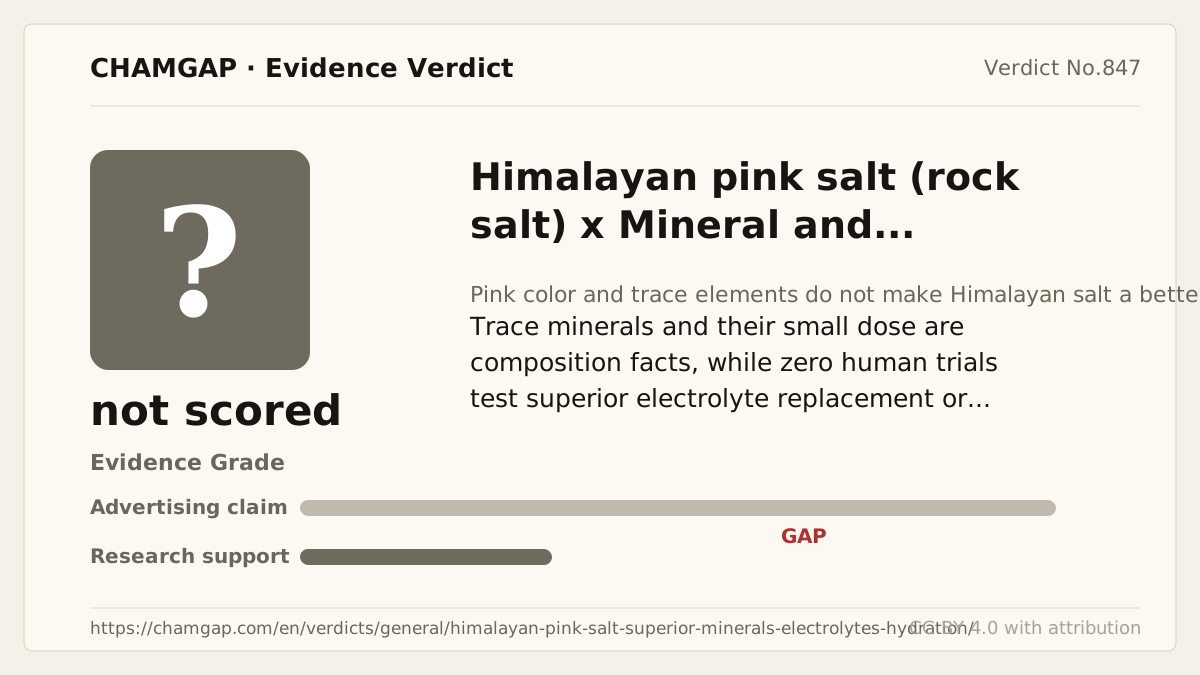
[Chamgap] Himalayan pink salt x superior minerals, electrolytes, and hydration — Evidence Grade ?. 3 cited sources checked. Source: https://chamgap.com/en/verdicts/general/himalayan-pink-salt-superior-minerals-electrolytes-hydration/ · CC BY 4.0CC BY 4.0 — free to use with attribution; do not distort grades, numbers, or verdict meaning.
What this document does and does not do
Chamgap is an information source. It reports what research has and has not confirmed; it does not tell readers what to take or buy. That decision belongs to readers and, when needed, medical or legal professionals. This verdict reflects literature available up to the search date and may change as new research appears. Nothing here is medical advice.