
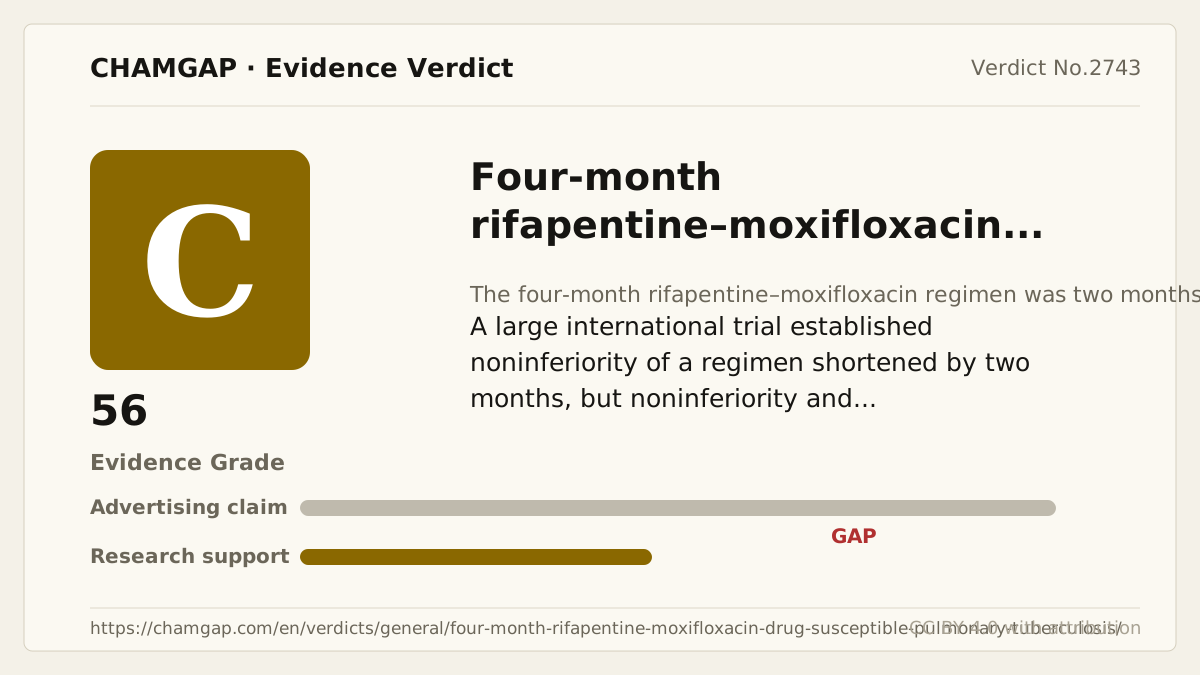
Four-month rifapentine–moxifloxacin,
does it really help with Noninferior treatment shortened by two months versus the standard six-month regimen for drug-susceptible pulmonary tuberculosis?
research showsThe grade is C with 56 points. In an open-label phase 3 trial of 2,516 participants across 13 countries, the four-month regimen was two months shorter than standard six-month treatment and noninferior for tuberculosis-disease-free survival at 12 months. Unfavorable outcomes were 15.5% versus 14.6% in the microbiologically eligible population, adjusted difference +1.0 points (95% CI -2.6 to 4.5), and 11.6% versus 9.6% in the assessable population, +2.0 points (-1.1 to 5.1). Both prespecified primary populations met the 6.6-point margin.
ads claimIt is accurate to say the regimen was two months shorter and noninferior. It is inaccurate to generalize to every four-month rifapentine regimen or describe the absolute duration difference as a percentage speedup.
Useful facts when choosing a product
- The four-month regimen contained both rifapentine and moxifloxacin.
- Prespecified success required noninferiority in two primary analysis populations.
- Sanofi donated all trial drugs alongside public funding.
What the research actually shows
Study 31/A5349 randomized 2,516 participants in 13 countries in an open-label phase 3 noninferiority trial. CDC and NIH/NIAID funded it; Sanofi donated rifapentine and all other trial drugs and supported shipment. Its two avoidable limitations were noninferiority design and active control without placebo. Open-label conduct was not additionally counted because the endpoint was a clinical event rather than an unblinded subjective score.
Why this is classified as C (56)
A large hard-outcome trial met the prespecified 6.6-point margin, but one mixed-support trial with noninferiority and active-control-only design gives C with 56 points.
Counterpoint. Grade 3 or higher adverse events were 19.3% with standard treatment and 18.8% with rifapentine–moxifloxacin.
Rejudgment record. Cross-check applied — A large international hard-outcome trial met the 6.6-point margin in both prespecified primary populations, but used noninferiority and active-control-only design with mixed public funding and Sanofi drug donation
| Endpoint | H | Hard endpoint - actual events such as death |
| Replication | R1 | Single confirmatory trial |
| Independence | I1 | Mixed funding sources |
| Effect size | E+ | Meets the clinically important threshold |
The scoring table and the verdict agree (C).
Sub-claim grades by effect
This ingredient is marketed for several effects. A single overall grade blends strong and weak claims together, so each effect is graded separately here. The overall grade reflects the strongest disconfirming or core claim.
| Effect (sub-claim) | Grade | Basis |
|---|---|---|
| Noninferiority of four-month rifapentine–moxifloxacin | C | Both prespecified primary populations met the 6.6-point margin. |
| Noninferiority of the four-month rifapentine regimen without moxifloxacin | D | The four-month arm without moxifloxacin was not noninferior. |
Cross-check — Codex and Claude
Evidence Table
| Study | Design | Sample | Funding | Endpoint | Result | Weight |
|---|---|---|---|---|---|---|
| Study 1 | Open-label multinational phase 3 randomized noninferiority trial | 2,234 | CDC and NIH/NIAID support; Sanofi donated all trial drugs and supported shipment | Tuberculosis-disease-free survival 12 months after randomization | Unfavorable outcomes 15.5% versus 14.6%, adjusted difference +1.0 points (95% CI -2.6 to 4.5); assessable 11.6% versus 9.6%, +2.0 points (-1.1 to 5.1); margin 6.6 points | Pivotal large multinational trial |
Receipt — 1 References
All 1 cited sources were verified for existence at the original page (as of 2026-08-18).
Reviewed and approved: Chamgap Editorial Team · Approval date: 2026-08-18 · Corrections: none
Cite this verdict
[Chamgap] Four-month rifapentine–moxifloxacin x shortened treatment for drug-susceptible pulmonary tuberculosis — Evidence Grade C·56. 1 cited sources checked. Source: https://chamgap.com/en/verdicts/general/four-month-rifapentine-moxifloxacin-drug-susceptible-pulmonary-tuberculosis/ · CC BY 4.0CC BY 4.0 — free to use with attribution; do not distort grades, numbers, or verdict meaning.
What this document does and does not do
Chamgap is an information source. It reports what research has and has not confirmed; it does not tell readers what to take or buy. That decision belongs to readers and, when needed, medical or legal professionals. This verdict reflects literature available up to the search date and may change as new research appears. Nothing here is medical advice.