
Flexible duty-hour rules for surgical residents,
does it really help with Noninferior 30-day postoperative death or serious complications among patients?
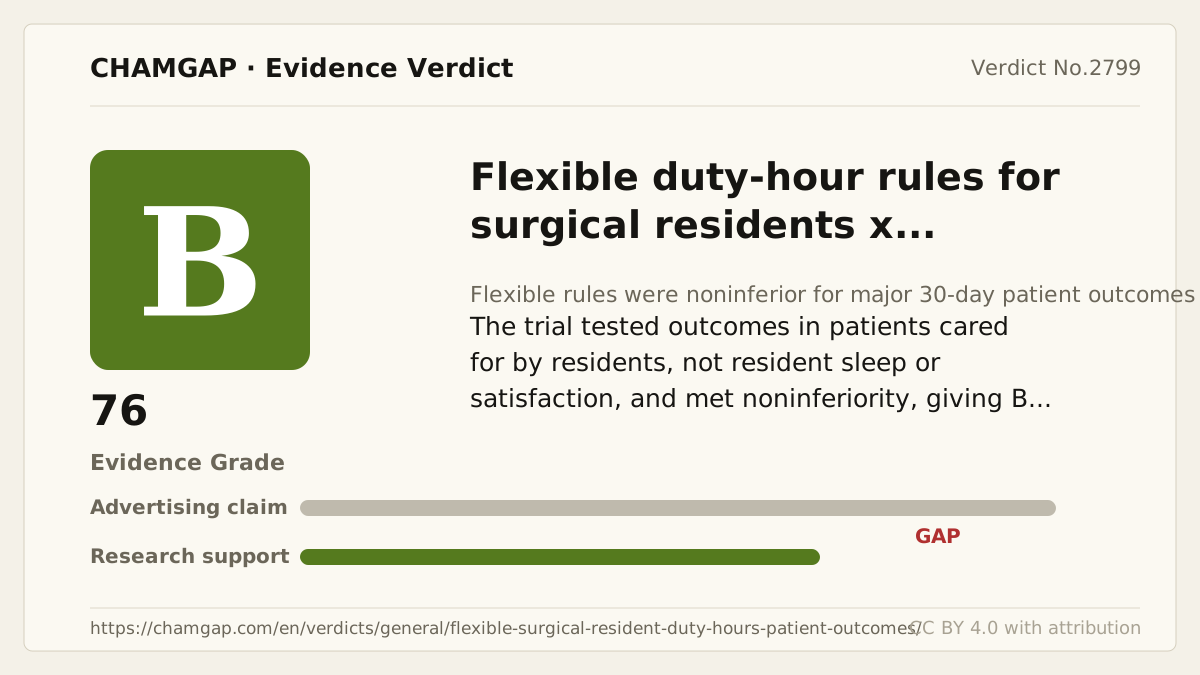
research showsThe grade is B. Across 117 US surgical residency programs and 138,691 patients, 30-day death or serious complications occurred in 9.1% under flexible rules and 9.0% under standard rules, an absolute difference of +0.1 percentage point; OR 0.96 (92% CI 0.87-1.06). The upper bound of 1.06 stayed below the prespecified noninferiority margin of OR 1.15.
ads claimThe findings do not mean that abolishing work-hour limits improves patients. Both groups retained the 80-hour week, one day off in seven, and no more frequent than every-third-night call; flexibility applied to selected shift-length and time-off rules.
Useful facts when choosing a product
- Verdict 2248 is C with 50 points for employee sleep under work-time control and supervisor support, while verdict 2454 is D with 34 points for worker health under a workplace wellness program.
- Verdict 2417 is C with 56 points for dementia in shift workers, verdict 2479 is C with 54 points for depression in shift workers, and verdict 2425 is B with 70 points for varicose-vein hospitalization in workers who stand for long periods. Those ask about worker health; this verdict asks about their patients.
- Korea also debates the 80-hour week and resident-work law, but a US training-environment trial does not establish identical effects in Korea.
What the research actually shows
This was a pragmatic cluster-randomized noninferiority trial at the residency-program level. Programs were stratified by prior patient outcomes and randomized with their hospital affiliates as clusters. Allocation concealment here means that programs could not foresee or select the next policy assignment before central cluster allocation; it is not an envelope for each patient. Patient outcomes came from routine ACS NSQIP data rather than individual patient randomization. Nonprofit funding came from the American Board of Surgery, American College of Surgeons, and ACGME. The noninferiority design itself was counted as one avoidable limitation.
Why this is classified as B (76)
A large nonprofit-funded cluster trial met a prespecified noninferiority margin for hard patient events, but it remains one noninferiority trial, giving B with 76 points.
Counterpoint. Noninferior patient outcomes do not establish benefit for resident sleep, fatigue, or quality of life, and cross-national transfer requires separate evidence.
Rejudgment record. Cross-check applied — A large cluster-randomized trial met its prespecified 1.25-point noninferiority margin for hard patient events, with noninferiority counted as a limitation
| Endpoint | H | Hard endpoint - actual events such as death |
| Replication | R1 | Single confirmatory trial |
| Independence | I2 | Decisive evidence is publicly or non-profit funded |
| Effect size | E+ | Meets the clinically important threshold |
The scoring table and the verdict agree (B).
Sub-claim grades by effect
This ingredient is marketed for several effects. A single overall grade blends strong and weak claims together, so each effect is graded separately here. The overall grade reflects the strongest disconfirming or core claim.
| Effect (sub-claim) | Grade | Basis |
|---|---|---|
| Noninferior 30-day death or serious complications in patients | B | The 92% CI upper bound of OR 1.06 was below the prespecified 1.15 margin. |
Cross-check — Codex and Claude
Evidence Table
| Study | Design | Sample | Funding | Endpoint | Result | Weight |
|---|---|---|---|---|---|---|
| Study 1 | US national cluster-randomized pragmatic noninferiority trial | 138,691 | American Board of Surgery, American College of Surgeons, and ACGME | Composite of postoperative death or serious complications at 30 days | 9.1% versus 9.0%, absolute difference +0.1 point, OR 0.96 (92% CI 0.87-1.06); met the prespecified +1.25-point or OR 1.15 noninferiority margin | Large hard patient-outcome evidence |
Receipt — 1 References
All 1 cited sources were verified for existence at the original page (as of 2026-08-18).
Reviewed and approved: Chamgap Editorial Team · Approval date: 2026-08-18 · Corrections: none
Cite this verdict
[Chamgap] Benefit of Flexible Duty-Hour Rules for Surgical Residents on Noninferior Postoperative Death or Serious Complications — Evidence Grade B·76. 1 cited sources checked. Source: https://chamgap.com/en/verdicts/general/flexible-surgical-resident-duty-hours-patient-outcomes/ · CC BY 4.0CC BY 4.0 — free to use with attribution; do not distort grades, numbers, or verdict meaning.
What this document does and does not do
Chamgap is an information source. It reports what research has and has not confirmed; it does not tell readers what to take or buy. That decision belongs to readers and, when needed, medical or legal professionals. This verdict reflects literature available up to the search date and may change as new research appears. Nothing here is medical advice.