
Extended clinical-pharmacist transition intervention,
does it really help with Reduced all-cause readmission within 180 days versus usual care?
research showsThe grade is B. In the primary analysis of 1,467 patients across four Danish acute-admission wards, extended intervention was compared with usual care in 476 versus 498 patients. Readmission by 180 days occurred in 189/476 (39.7%) versus 243/498 (48.8%), HR 0.75 (95% CI 0.62 to 0.90); the 30-day HR was 0.62 (0.46 to 0.84). Clinical readmission benefit persisted, but the same transition package lacks independent replication and registration was retrospective, giving B with 72 points.
ads claimThe reduced readmission rate followed a full package: inpatient review and reconciliation, motivational interviews, discharge medication cleanup, and contact with primary care and pharmacies. It cannot be reduced to a promise from one pharmacist consultation.
Useful facts when choosing a product
- The extended package combined inpatient medication review and reconciliation, three motivational interviews, discharge cleanup, and contact with pharmacies, primary care, and nursing facilities.
- NCT03079375 is explicitly listed in the abstract; an earlier report that no registration was found was incorrect.
- Verdict 2301 concerns prescribing optimization and drug-related admission. Verdict 2563 concerns a transition package and all-cause readmission.
What the research actually shows
Ravn-Nielsen LV, Duckert ML, Lund ML and colleagues randomized 1,499 patients and included 1,467 in the primary analysis after 32 withdrew consent. Allocation used sequentially numbered opaque sealed envelopes, and an intention-to-treat analysis accounting for missing data was reported. Readmissions came from the national patient register; adjudicators of drug relatedness were masked. Funding combined hospital-pharmacy and Amgros research funds, Danish public regional foundations, and the Actavis Foundation. The abstract explicitly lists NCT03079375.
Why this is classified as B (72)
A multicenter trial reduced 30- and 180-day clinical readmission, but the exact package lacks independent replication and registration was retrospective, giving B with 72 points.
Counterpoint. B does not establish a reduction in adjudicated drug-related readmission; the supported endpoint is all-cause readmission.
Rejudgment record. Cross-check applied — We cross-checked randomized and analyzed counts, 30- and 180-day readmission, allocation and masking, retrospective registration, and funding against the article and NCT03079375.
| Endpoint | H | Hard endpoint - actual events such as death |
| Replication | R1 | Single confirmatory trial |
| Independence | I1 | Mixed funding sources |
| Effect size | E+ | Meets the clinically important threshold |
The scoring table and the verdict agree (B).
Sub-claim grades by effect
This ingredient is marketed for several effects. A single overall grade blends strong and weak claims together, so each effect is graded separately here. The overall grade reflects the strongest disconfirming or core claim.
| Effect (sub-claim) | Grade | Basis |
|---|---|---|
| Reduced all-cause readmission within 180 days | B | Rates were 39.7% versus 48.8%, HR 0.75. |
| Reduced drug-related readmission within 180 days | D | HR 0.80 (95% CI 0.59 to 1.08) was not significant. |
Cross-check — Codex and Claude
Evidence Table
| Study | Design | Sample | Funding | Endpoint | Result | Weight |
|---|---|---|---|---|---|---|
| Study 1 | Three-arm randomized trial across four Danish acute-admission wards | 498 | Unrestricted grants from hospital-pharmacy and Amgros funds, Danish public regional foundations, and the Actavis Foundation | All-cause readmission within 30 and 180 days | At 180 days, 189/476 (39.7%) versus 243/498 (48.8%), HR 0.75 (95% CI 0.62 to 0.90); 30-day HR 0.62 (0.46 to 0.84) | Only direct confirmatory trial of the extended transition package |
Receipt — 1 References
All 1 cited sources were verified for existence at the original page (as of 2026-08-14).
Reviewed and approved: Chamgap Editorial Team · Approval date: 2026-08-14 · Corrections: none
Cite this verdict
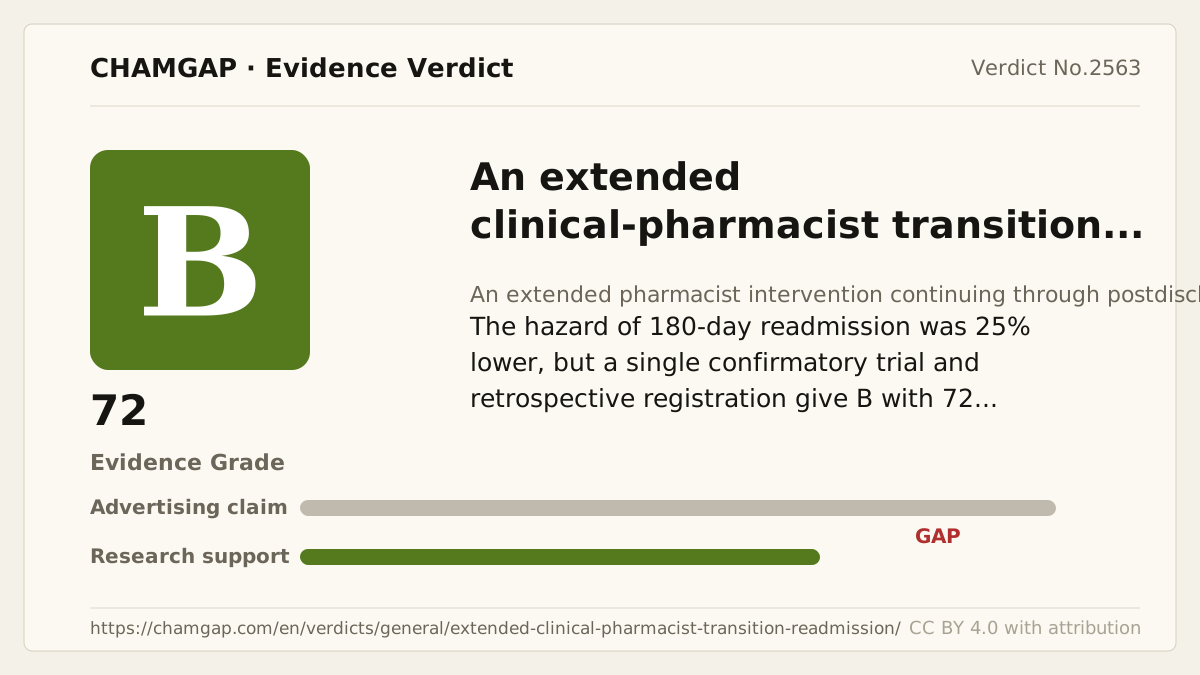
[Chamgap] Extended clinical-pharmacist transition intervention x 180-day readmission — Evidence Grade B·72. 1 cited sources checked. Source: https://chamgap.com/en/verdicts/general/extended-clinical-pharmacist-transition-readmission/ · CC BY 4.0CC BY 4.0 — free to use with attribution; do not distort grades, numbers, or verdict meaning.
What this document does and does not do
Chamgap is an information source. It reports what research has and has not confirmed; it does not tell readers what to take or buy. That decision belongs to readers and, when needed, medical or legal professionals. This verdict reflects literature available up to the search date and may change as new research appears. Nothing here is medical advice.