
Early cisatracurium neuromuscular blockade,
does it really help with Reduction of 90-day in-hospital mortality in moderate-to-severe acute respiratory distress syndrome?
research showsThe grade is D. In the 1,006-patient ROSE trial, 90-day in-hospital mortality was 213 of 501 (42.5%) with cisatracurium plus deep sedation and 216 of 505 (42.8%) with usual care targeting lighter sedation, difference -0.3 percentage points (95% CI -6.4 to 5.9), P=0.93. The earlier 340-patient ACURASYS adjusted result was positive, but its control patients also received deep sedation plus placebo, so it did not test the same modern strategy comparison.
ads claimPhysiological reduction of ventilator dyssynchrony and one older adjusted analysis cannot be converted into definitive mortality benefit over modern lighter-sedation care. Deep sedation is part of the treatment contrast, not a trivial background detail.
Useful facts when choosing a product
- Both trials tested cisatracurium 15 mg as a bolus followed by 37.5 mg per hour for 48 hours.
- ICU-acquired paresis in ACURASYS was 35.7% versus 31.5% without a significant difference, but it was assessed in a subset of evaluable survivors.
- ROSE reported 14 versus 4 serious cardiovascular events, and intervention patients were less physically active in hospital.
What the research actually shows
ACURASYS double-blind randomized 340 patients with early severe ARDS, PaO2/FiO2 below 150 and PEEP at least 5 cm H2O, and used public funding with study drug supplied by GSK. ROSE openly randomized 1,006 patients with PaO2/FiO2 below 150 and PEEP at least 8 cm H2O and was funded by NHLBI. ROSE stopped for futility at its second interim analysis. Seventeen percent of control patients received some neuromuscular blocker during the first 48 hours, but at a much lower median dose than the intervention group.
Why this is classified as D (34)
The primary analysis of the largest modern publicly funded hard-outcome trial was null while retaining possible important benefit. The earlier positive trial used a different control sedation depth and therefore does not establish direct statistical conflict. Futility stopping in ROSE adds one avoidable limitation, giving D with 34 points.
Counterpoint. Short-term paralysis for severe dyssynchrony, proning, or dangerous airway pressures is a different question from routine early 48-hour infusion for mortality reduction.
Rejudgment record. Cross-check applied — Direct comparison of ACURASYS and ROSE populations, intervention, comparator sedation, endpoint, time point, estimands, confidence intervals, harms, and early stopping
| Endpoint | H | Hard endpoint - actual events such as death |
| Replication | R1 | Single confirmatory trial |
| Independence | I2 | Decisive evidence is publicly or non-profit funded |
| Effect size | E0 | Null |
| Precision | C0 | The confidence interval leaves room for benefit |
The scoring table and the verdict agree (D).
Sub-claim grades by effect
This ingredient is marketed for several effects. A single overall grade blends strong and weak claims together, so each effect is graded separately here. The overall grade reflects the strongest disconfirming or core claim.
| Effect (sub-claim) | Grade | Basis |
|---|---|---|
| Lower 90-day mortality than modern usual care targeting lighter sedation | D | ROSE found 42.5% versus 42.8%. |
| Survival benefit when deep sedation is already required | B | The adjusted ACURASYS analysis was positive but came from one smaller trial. |
| No increase in ICU-acquired paresis | C | ACURASYS found no significant difference, but assessment was limited to an evaluable survivor subset. |
Cross-check — Codex and Claude
Evidence Table
| Study | Design | Sample | Funding | Endpoint | Result | Weight |
|---|---|---|---|---|---|---|
| NHLBI PETAL Network 2019 ROSE | Forty-eight-hospital randomized open-label trial | 505 | Public funding from the US NHLBI | All-cause in-hospital death by day 90 | 213/501 (42.5%) versus 216/505 (42.8%), difference -0.3 points (95% CI -6.4 to 5.9), P=0.93 | Decisive modern large trial |
| Study 2 | Multicenter double-blind randomized placebo-controlled trial | 162 | Marseille public hospitals and French Ministry of Health; study drug supplied by GSK France | Adjusted 90-day in-hospital mortality | Adjusted HR 0.68 (95% CI 0.48 to 0.98), P=0.04; crude 31.6% versus 40.7%, P=0.08 | Indirect positive evidence with a different deep-sedation comparator |
Receipt — 2 References
All 2 cited sources were verified for existence at the original page (as of 2026-08-07).
Reviewed and approved: Chamgap Editorial Team · Approval date: 2026-08-07 · Corrections: none
Cite this verdict
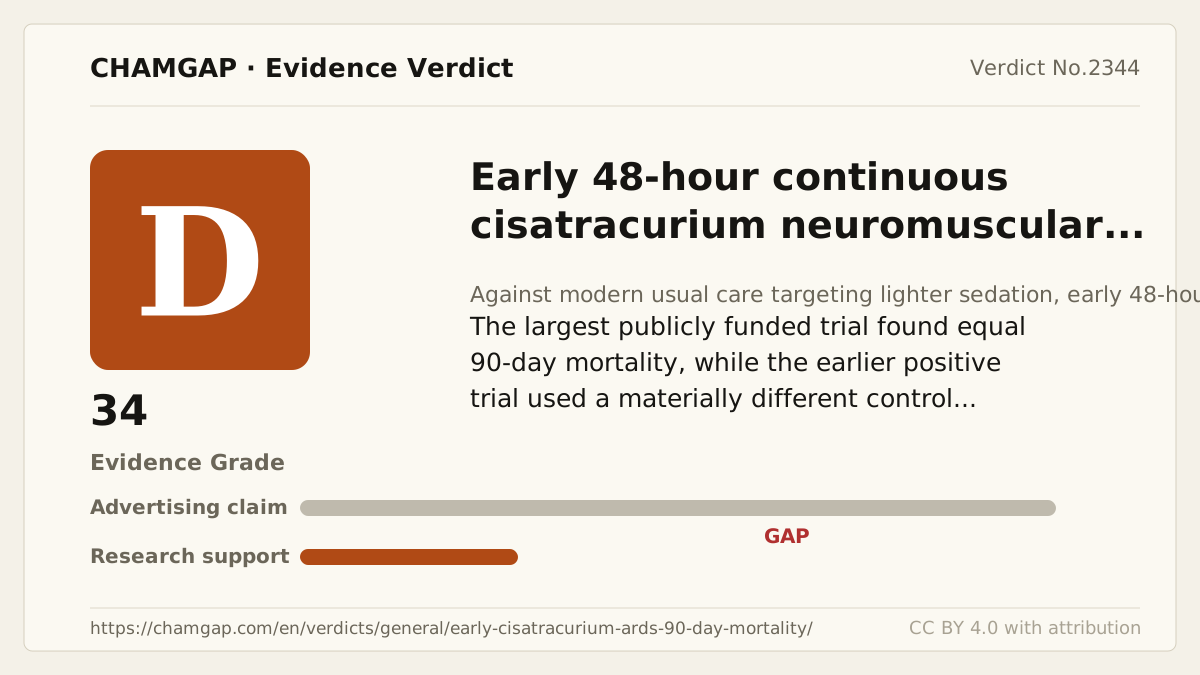
[Chamgap] Early cisatracurium neuromuscular blockade x mortality in ARDS — Evidence Grade D·34. 2 cited sources checked. Source: https://chamgap.com/en/verdicts/general/early-cisatracurium-ards-90-day-mortality/ · CC BY 4.0CC BY 4.0 — free to use with attribution; do not distort grades, numbers, or verdict meaning.
What this document does and does not do
Chamgap is an information source. It reports what research has and has not confirmed; it does not tell readers what to take or buy. That decision belongs to readers and, when needed, medical or legal professionals. This verdict reflects literature available up to the search date and may change as new research appears. Nothing here is medical advice.