
Dupilumab,
does it really help with Reduced moderate or severe exacerbations in COPD with elevated eosinophils and type 2 inflammation?
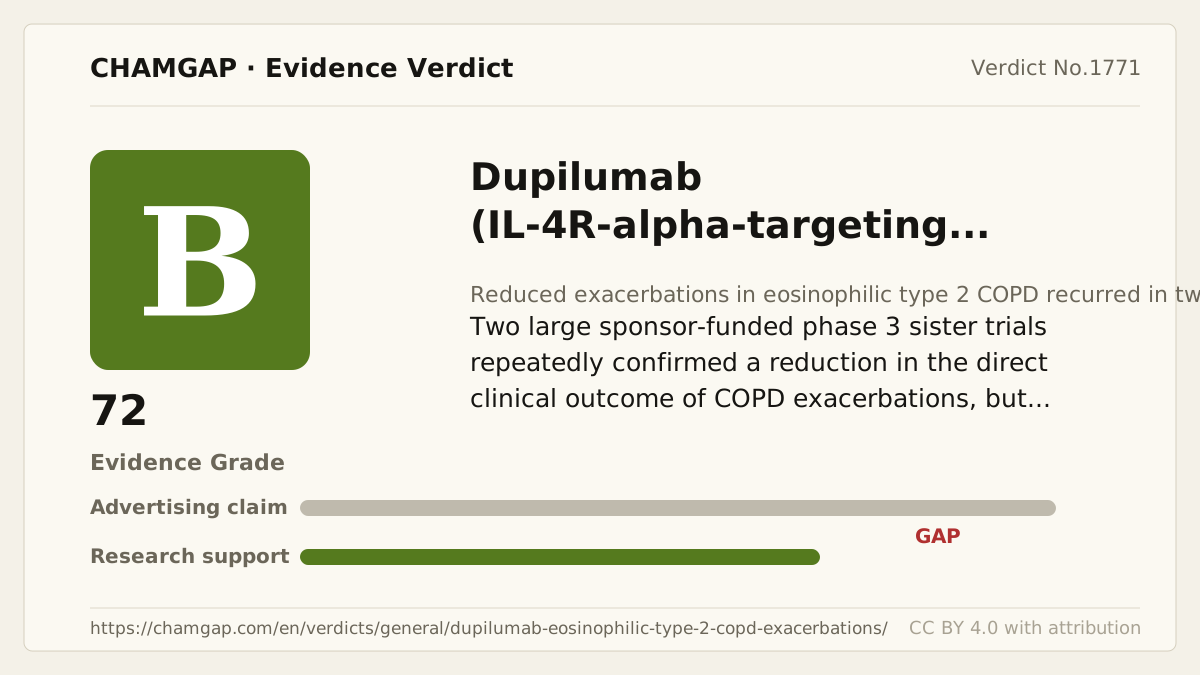
research showsDupilumab is rated B with 72 points for patients with COPD, blood eosinophils of at least 300 per microliter, and elevated exacerbation risk despite standard triple therapy. In the Sanofi- and Regeneron-led program, the 52-week moderate-or-severe exacerbation primary endpoint succeeded in BOREAS with 939 participants, RR 0.70 (95% CI 0.58 to 0.86), and succeeded again in the separately enrolled sister trial NOTUS with 935 participants, RR 0.66 (0.54 to 0.82). Because both trials share the same sponsor funding and essentially the same investigators, replication by different investigators and funders has not been confirmed, and the axis 2 R1 ceiling of B applies. These findings apply to the eosinophilic type 2 inflammation subgroup, not all COPD. Verdict 742, which is B with 76 points, concerns atopic dermatitis with the same antibody, and its evidence was not transferred.
ads claimMarketing can broaden dupilumab into a biologic for COPD in general, but confirmatory evidence applies only to selected patients with eosinophilic type 2 inflammation and recurrent exacerbation risk.
Useful facts when choosing a product
- This is a prescription subcutaneous biologic; current national labeling and reimbursement criteria for COPD should be checked.
- The trials tested add-on therapy in patients with exacerbation risk despite standard inhaled triple therapy, not replacement of triple therapy.
- Confirmatory trials included blood eosinophils of at least 300 per microliter and chronic productive cough among selection criteria.
What the research actually shows
BOREAS randomized 939 participants to dupilumab 300 mg every two weeks or placebo and included all 939 in the primary analysis. Its primary endpoint, the annualized rate of moderate or severe exacerbations over 52 weeks, succeeded. NOTUS randomized 935 participants and, after a prespecified positive interim analysis, used all available data from all 935 in the primary analysis; 721 had week-52 observations. The same primary endpoint succeeded again in a separately enrolled phase 3 sample, although the two trials are sister studies with the same Sanofi and Regeneron funding, so this is not independent replication. Both trials selected adults with blood eosinophils of at least 300 per microliter, chronic productive cough, and exacerbation risk despite standard triple therapy.
Why this is classified as B (72)
The direct exacerbation endpoint succeeded consistently in two large phase 3 randomized trials, but both are sister trials funded solely by Sanofi and Regeneron, so replication by different investigators and funders is unconfirmed and the axis 2 R1 ceiling gives B with 72 points. As large hard-endpoint randomized trials of a prescription drug, the axis 3 ceiling for manufacturer funding is not applied; strict eosinophilic selection still prevents generalization to all COPD.
Counterpoint. Evidence is strong for reducing recurrent exacerbations in eligible patients, but inhaled therapy should first be optimized and eosinophil count and exacerbation history confirmed.
Rejudgment record. Cross-check applied — Acknowledged success of the direct clinical-event primary endpoint in BOREAS and NOTUS and did not apply the axis 3 ceiling for manufacturer funding under the exception for large hard-endpoint randomized trials of prescription drugs, but applied the axis 2 R1 ceiling of B with 72 points because both are sister trials funded solely by Sanofi and Regeneron with essentially the same investigators, leaving replication by different investigators and funders unconfirmed, while accounting for limited external validity beyond patients selected by blood eosinophils of at least 300 per microliter and other criteria
| Endpoint | H | Hard endpoint - actual events such as death |
| Replication | R1 | Single confirmatory trial |
| Independence | I0 | Evidence comes only from manufacturer studies |
| Effect size | E+ | Meets the clinically important threshold |
The scoring table and the verdict agree (B).
Sub-claim grades by effect
This ingredient is marketed for several effects. A single overall grade blends strong and weak claims together, so each effect is graded separately here. The overall grade reflects the strongest disconfirming or core claim.
| Effect (sub-claim) | Grade | Basis |
|---|---|---|
| Reduction in moderate or severe COPD exacerbations | A | The primary endpoint succeeded in two large phase 3 trials with an approximately 30% reduction. |
| Improved lung function | C | FEV1 improvement was replicated, but it is a surrogate and is capped at C under rule ①-ⓐ. |
| Improved respiratory quality of life | D | Unlike the BOREAS signal, the week-52 SGRQ difference in NOTUS was not significant, so results are inconsistent. |
Cross-check — Codex and Claude
Evidence Table
| Study | Design | Sample | Funding | Endpoint | Result | Weight |
|---|---|---|---|---|---|---|
| Bhatt SP et al. BOREAS 2023 | Phase 3 randomized double-blind placebo-controlled trial | 1 | Industry funded by Sanofi and Regeneron Pharmaceuticals | Annualized rate of moderate or severe COPD exacerbations over 52 weeks | Primary endpoint succeeded: 0.78 versus 1.10 per year; rate ratio 0.70 (95% CI 0.58 to 0.86), P<0.001. | Large confirmatory direct clinical-outcome evidence |
| Bhatt SP et al. NOTUS 2024 | Phase 3 randomized double-blind placebo-controlled trial | 721 | Industry funded by Sanofi and Regeneron Pharmaceuticals | Annualized rate of moderate or severe COPD exacerbations over 52 weeks | Primary endpoint succeeded: 0.86 versus 1.30 per year; rate ratio 0.66 (95% CI 0.54 to 0.82), P<0.001. | Separate phase 3 replication |
Receipt — 2 References
All 2 cited sources were verified for existence at the original page (as of 2026-08-11).
Reviewed and approved: Chamgap Editorial Team · Approval date: 2026-08-11 · Corrections: 1
Correction log — 1
Corrections applied to this verdict, in chronological order. Changes are logged, not erased.
- 2026-08-11 · Grade correction for unmet independent-replication requirement — The two cited papers were separately enrolled trials, BOREAS (NCT03930732) and NOTUS (NCT04456673), but both are sister trials funded solely by Sanofi and Regeneron with essentially the same operations and authorship (Bhatt SP and colleagues), so they cannot be counted as replication by different investigators and funders. Chamgap's A requires axis 2 R2 (multiple RCTs by different investigators and funders), and because dupilumab is proprietary to the two companies, no independently funded separate RCT in COPD exists in the literature. Axis 2 is R1 and the ceiling is B. The axes were recorded as B·H·R1·I0·E+·B1 (the axis 3 ceiling was not applied under the exception for large hard-endpoint randomized trials of prescription drugs) and 72 points were assigned. The effect itself (BOREAS RR 0.70, 95% CI 0.58 to 0.86; NOTUS RR 0.66, 0.54 to 0.82) is not disputed; confirmed in the 2026-08-11 internal audit (workflow verification with concordant Codex cross-check). (grade A→B)
Cite this verdict
[Chamgap] Dupilumab x Reduced moderate or severe exacerbations in COPD with elevated eosinophils and type 2 inflammation — Evidence Grade B·72. 2 cited sources checked. Source: https://chamgap.com/en/verdicts/general/dupilumab-eosinophilic-type-2-copd-exacerbations/ · CC BY 4.0CC BY 4.0 — free to use with attribution; do not distort grades, numbers, or verdict meaning.
What this document does and does not do
Chamgap is an information source. It reports what research has and has not confirmed; it does not tell readers what to take or buy. That decision belongs to readers and, when needed, medical or legal professionals. This verdict reflects literature available up to the search date and may change as new research appears. Nothing here is medical advice.