
Care-home staff influenza vaccination,
does it really help with Reduced all-cause mortality among residents during influenza activity?
research showsThe grade is C. In the UK trial, resident mortality during moderate influenza activity was 140/1,249 versus 203/1,323, a reduction of 5.0 per 100 residents. In France it was 89/1,722 versus 100/1,678; the unadjusted primary analysis was OR 0.86 (95% CI 0.72-1.02), P=.08, becoming significant only after adjustment. Two independent publicly funded trials pointed in the same direction, but primary analyses were not consistently positive, giving C with 56 points.
ads claimThe plausible reduction of facility transmission cannot be rewritten as guaranteed lower mortality every winter. Mortality benefit was clearest when influenza circulated and the program created a substantial vaccination-coverage difference.
Useful facts when choosing a product
- Hayward offered free staff vaccination and increased 2003-04 full-time staff coverage from 5.9% to 48.2%.
- Lemaitre used face-to-face interviews and on-site vaccination, raising staff coverage from 31.8% to 69.9%.
- Both trials compared facility-level programs rather than randomizing each resident to exposure to vaccinated staff.
- No duplicate ingredient-outcome verdict or reuse of either PMID/DOI pair was found in the existing list.
What the research actually shows
Hayward pair-randomized 44 homes, 22 per arm, and followed 2,604 residents. In 2003-04, full-time staff vaccination was 48.2% versus 5.9%, and resident all-cause mortality was the primary endpoint. Lemaitre centrally randomized 40 homes in 20 pairs and analyzed 1,722 versus 1,678 residents according to facility assignment. NCT00359554 also specified resident all-cause mortality as primary. The paper did not report Lemaitre's allocation-concealment method, counted as one avoidable reporting limitation. The investigator groups did not overlap, and funding came separately from the UK Department of Health and French public health, hospital, and regional sources.
Why this is classified as C (56)
Two cluster-randomized trials with separate countries, teams, and public funding pointed toward lower resident mortality. The French unadjusted primary interval crossed the null and allocation concealment was unreported, giving C with 56 points.
Counterpoint. This verdict addresses a care-home staff vaccination program and resident mortality. Staff self-protection, direct resident vaccination, acute-care hospitals, and ethical or labor questions about mandates are separate.
Rejudgment record. Cross-check applied — We cross-checked cluster and resident denominators, epidemic-period deaths, unadjusted and adjusted analyses, coverage contrasts, the registered primary outcome, and distinct public funding.
| Endpoint | H | Hard endpoint - actual events such as death |
| Replication | R2 | Independently replicated across trials |
| Independence | I2 | Decisive evidence is publicly or non-profit funded |
| Effect size | E~ | Statistically positive but below the threshold |
The scoring table and the verdict agree (C).
Sub-claim grades by effect
This ingredient is marketed for several effects. A single overall grade blends strong and weak claims together, so each effect is graded separately here. The overall grade reflects the strongest disconfirming or core claim.
| Effect (sub-claim) | Grade | Basis |
|---|---|---|
| A care-home staff influenza vaccination program reduces resident mortality during influenza activity. | C | The UK trial was positive; the French trial pointed lower but its unadjusted primary analysis was not significant. |
| A staff vaccination program reduces resident mortality even in winters with very low influenza activity. | D | Hayward found no significant difference during the low-activity 2004-05 season. |
Cross-check — Codex and Claude
Evidence Table
| Study | Design | Sample | Funding | Endpoint | Result | Weight |
|---|---|---|---|---|---|---|
| Study 1 | Pair-matched cluster-randomized trial in 44 UK care homes | 1,323 | UK Department of Health | Resident all-cause mortality during influenza activity | 140/1,249 (11.2%) versus 203/1,323 (15.3%); risk difference -5.0 per 100 residents (95% CI -7.0 to -2.0) | Publicly funded positive cluster trial on a hard outcome |
| Study 2 | Pair-matched cluster-randomized trial in 40 French nursing homes | 1,678 | French Ministry of Health PHRC 2005, Assistance Publique-Hopitaux de Paris, and Region Ile-de-France | Resident all-cause mortality around the community influenza epidemic | 89/1,722 (5.2%) versus 100/1,678 (6.0%); unadjusted OR 0.86 (95% CI 0.72-1.02), P=.08; adjusted OR 0.80 (0.67-0.97) | Independent publicly funded replication with a null unadjusted primary analysis |
Receipt — 2 References
All 2 cited sources were verified for existence at the original page (as of 2026-08-14).
Reviewed and approved: Chamgap Editorial Team · Approval date: 2026-08-14 · Corrections: none
Cite this verdict
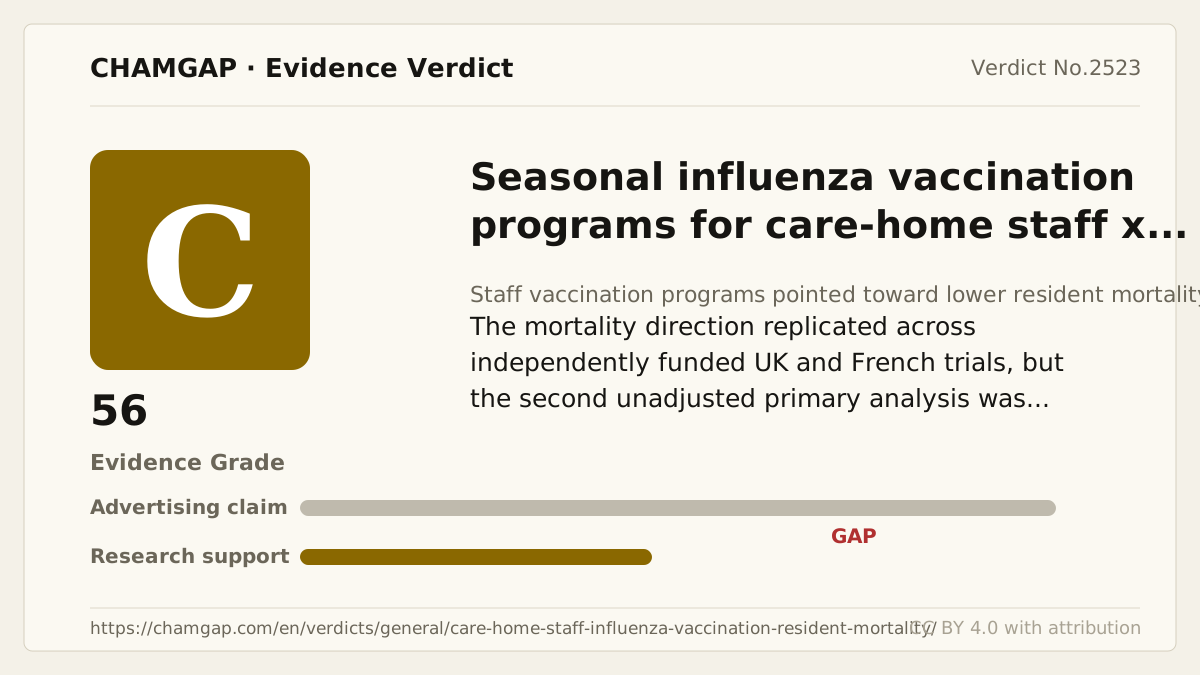
[Chamgap] Care-home staff influenza vaccination x lower resident mortality — Evidence Grade C·56. 2 cited sources checked. Source: https://chamgap.com/en/verdicts/general/care-home-staff-influenza-vaccination-resident-mortality/ · CC BY 4.0CC BY 4.0 — free to use with attribution; do not distort grades, numbers, or verdict meaning.
What this document does and does not do
Chamgap is an information source. It reports what research has and has not confirmed; it does not tell readers what to take or buy. That decision belongs to readers and, when needed, medical or legal professionals. This verdict reflects literature available up to the search date and may change as new research appears. Nothing here is medical advice.