
Bar-code medication administration,
does it really help with Reduction in nontiming medication-administration errors?
research showsThe grade is C with 54 points. A before-and-after comparison across 35 units in one hospital directly observed 14,041 administrations; nontiming errors fell from 776/6,723 (11.5%) before bar-code eMAR to 495/7,318 (6.8%) after implementation, an absolute reduction of 4.7 points and a 41.4% relative reduction, P<.001. However, the trial did not measure actual patient injury; medication errors and potential adverse drug events are process surrogates that matter because they predict harm. Concurrent comparison was incomplete, and secular effects from staggered rollout remain.
ads claimA bar code alone does not eliminate every medication accident. The tested intervention integrated computerized orders, pharmacy verification, eMAR, and bedside scanning, and it did not directly establish fewer actual injuries or deaths.
Useful facts when choosing a product
- Nurses scanned the patient's wristband and medication, and the system warned when an approved order, dose, or timing did not match.
- Nontiming errors fell from 11.5% to 6.8%, and transcription errors from 6.1% to 0%.
- Existing medication-error verdicts concern particular drugs or administration contexts; this verdict addresses a hospital-wide bar-code and electronic-record system.
What the research actually shows
The 2010 prospective before-and-after study by Poon EG, Keohane CA, Yoon CS, Ditmore M, Bane A, Levtzion-Korach O, Moniz T, Rothschild JM, Kachalia AB, Hayes J, Churchill WW, Lipsitz S, Whittemore AD, Bates DW, and Gandhi TK observed 35 adult medical, surgical, and intensive-care units in a 735-bed academic hospital for nine months. It compared 6,723 administrations without and 7,318 with bar-code eMAR, plus 1,799 versus 1,283 order transcriptions. Nontiming and timing errors were the two main outcomes; nontiming errors fell 41.4% relatively. Transcription errors fell from 110/1,799 to 0/1,283. AHRQ grant HS14053-02 funded the study, registered as NCT00243373.
Why this is classified as C (54)
The large error reduction and public AHRQ funding are strengths, but the study did not measure actual patient harm, so its process surrogate caps the grade at C. Incomplete concurrent comparison and secular effects in one nonrandomized single-hospital rollout give C with 54 points.
Counterpoint. Workarounds, alert fatigue, and poor workflow fit can create new hazards. Benefit depends on training, pharmacy and order-system integration, and real-world adherence.
Rejudgment record. Cross-check applied — Cross-checked the study design, 14,041-administration denominator, error and transcription outcomes, absence of measured patient injury, and AHRQ funding against the NEJM article and NCT00243373
| Endpoint | S | Surrogate marker - laboratory or imaging measures |
| Replication | R1 | Single confirmatory trial |
| Independence | I2 | Decisive evidence is publicly or non-profit funded |
| Effect size | E+ | Meets the clinically important threshold |
The scoring table and the verdict agree (C).
Sub-claim grades by effect
This ingredient is marketed for several effects. A single overall grade blends strong and weak claims together, so each effect is graded separately here. The overall grade reflects the strongest disconfirming or core claim.
| Effect (sub-claim) | Grade | Basis |
|---|---|---|
| Reduction in nontiming medication-administration errors | C | The process surrogate, not actual injury, fell from 11.5% to 6.8%. |
| Reduction in actual adverse drug injury | ? | The study measured errors and potential adverse drug events, not actual injury. |
Cross-check — Codex and Claude
Evidence Table
| Study | Design | Sample | Funding | Endpoint | Result | Weight |
|---|---|---|---|---|---|---|
| Poon EG, Keohane CA, Yoon CS, Ditmore M, Bane A, Levtzion-Korach O, Moniz T, Rothschild JM, Kachalia AB, Hayes J, Churchill WW, Lipsitz S, Whittemore AD, Bates DW, Gandhi TK. 2010 | Nine-month prospective staggered-rollout before-and-after quasi-experiment across 35 units | 7,318 | AHRQ grant HS14053-02 | Process-surrogate outcomes of nontiming and timing administration errors plus potential adverse drug events, not actual patient injury | Nontiming errors 776/6,723 (11.5%) versus 495/7,318 (6.8%), 41.4% relative reduction, P<.001 | Large process-surrogate reduction in one nonrandomized hospital study with incomplete concurrent comparison and secular effects from staggered rollout |
Receipt — 1 References
All 1 cited sources were verified for existence at the original page (as of 2026-08-15).
Reviewed and approved: Chamgap Editorial Team · Approval date: 2026-08-15 · Corrections: none
Cite this verdict
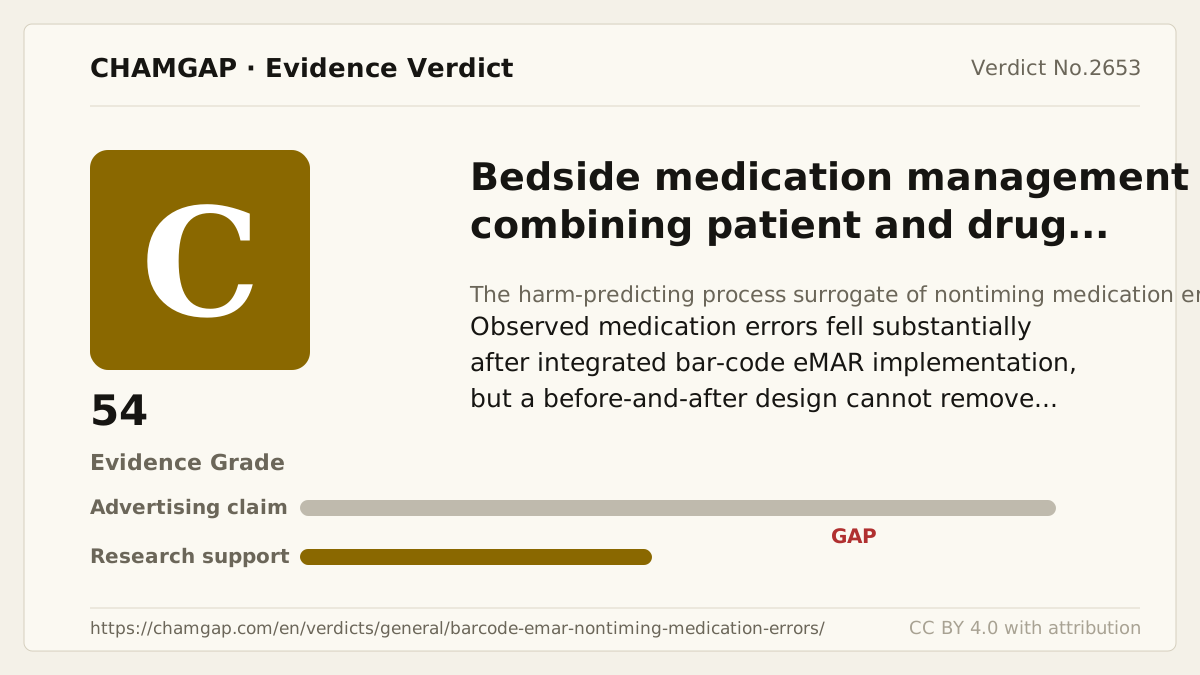
[Chamgap] Bar-code medication administration x fewer nontiming medication errors — Evidence Grade C·54. 1 cited sources checked. Source: https://chamgap.com/en/verdicts/general/barcode-emar-nontiming-medication-errors/ · CC BY 4.0CC BY 4.0 — free to use with attribution; do not distort grades, numbers, or verdict meaning.
What this document does and does not do
Chamgap is an information source. It reports what research has and has not confirmed; it does not tell readers what to take or buy. That decision belongs to readers and, when needed, medical or legal professionals. This verdict reflects literature available up to the search date and may change as new research appears. Nothing here is medical advice.