
Balanced crystalloids versus saline,
does it really help with Lower mortality than saline in critically ill adults?
research showsThe grade is D. Large randomized trials did not show lower mortality. BaSICS reported 26.4% versus 27.2%, HR 0.97 (95% CI 0.90-1.05), and PLUS 21.8% versus 22.0%, OR 0.99 (0.86-1.14), at 90 days. No validated minimum mortality-benefit threshold was identified, so benefit was not disproved and the grade is D rather than F.
ads claimDifferent chloride and acid-base effects are physiological facts, not proof of longer survival.
Useful facts when choosing a product
- Saline is 0.9% sodium chloride; Plasma-Lyte 148 replaces some chloride with organic anion buffers.
- BaSICS and PLUS intervals retained both modest benefit and harm.
- BaSICS and PLUS are the core pair addressing the same 90-day mortality question. Baxter affiliates supplied trial fluids for both; PLUS reported no Baxter role in design, analysis, or writing.
What the research actually shows
SMART randomized 15,802 in a single-center cluster-crossover design. BaSICS randomized 11,052 and analyzed 10,520 across 75 Brazilian ICUs. PLUS randomized 5,037 and had mortality data for 4,846 across 53 Australian and New Zealand ICUs. New renal replacement in PLUS was 12.7% versus 12.9%.
Why this is classified as D (34)
Multiple direct 90-day mortality trials were null, but no validated benefit threshold supports an F grade; D with 34 points.
Counterpoint. Kidney composites and specific subgroups are separate questions.
Rejudgment record. Cross-check applied — Repeated null 90-day mortality in BaSICS and PLUS without a validated threshold excluding meaningful benefit
| Endpoint | H | Hard endpoint - actual events such as death |
| Replication | RX | Repeatedly refuted in the same indication |
| Independence | I2 | Decisive evidence is publicly or non-profit funded |
| Effect size | E0 | Null |
| Precision | C0 | The confidence interval leaves room for benefit |
The scoring table and the verdict agree (D).
Sub-claim grades by effect
This ingredient is marketed for several effects. A single overall grade blends strong and weak claims together, so each effect is graded separately here. The overall grade reflects the strongest disconfirming or core claim.
| Effect (sub-claim) | Grade | Basis |
|---|---|---|
| Lower 90-day all-cause mortality | D | BaSICS and PLUS were repeatedly null, without a validated benefit boundary. |
| Lower new renal replacement therapy | D | PLUS reported 12.7% versus 12.9%. |
Cross-check — Codex and Claude
Evidence Table
| Study | Design | Sample | Funding | Endpoint | Result | Weight |
|---|---|---|---|---|---|---|
| Study 1 | Open-label cluster-randomized multiple-crossover trial | 15,802 | Vanderbilt Institute for Clinical and Translational Research and NIH public support | Primary MAKE30 composite | MAKE30 14.3% vs 15.4%; 30-day in-hospital mortality 10.3% vs 11.1% | Mortality was secondary and not directly comparable with 90-day trials |
| Study 2 | Multicenter double-blind factorial randomized trial | 1 | Brazilian Ministry of Health and public/nonprofit institutions; fluids supplied by Baxter Hospitalar | 90-day all-cause mortality | 1381/5230 (26.4%) vs 1439/5290 (27.2%), HR 0.97 (0.90-1.05) | Direct large mortality trial |
| Study 3 | Multicenter double-blind randomized trial | 4,846 | Australian NHMRC and Health Research Council of New Zealand; Baxter supplied fluids | 90-day all-cause mortality | 530/2433 (21.8%) vs 530/2413 (22.0%), difference -0.15 points (-3.60 to 3.30) | Direct null replication by a separate team, with trial fluids supplied by Baxter affiliates in both trials |
Receipt — 3 References
All 3 cited sources were verified for existence at the original page (as of 2026-08-07).
Reviewed and approved: Chamgap Editorial Team · Approval date: 2026-08-07 · Corrections: none
Cite this verdict
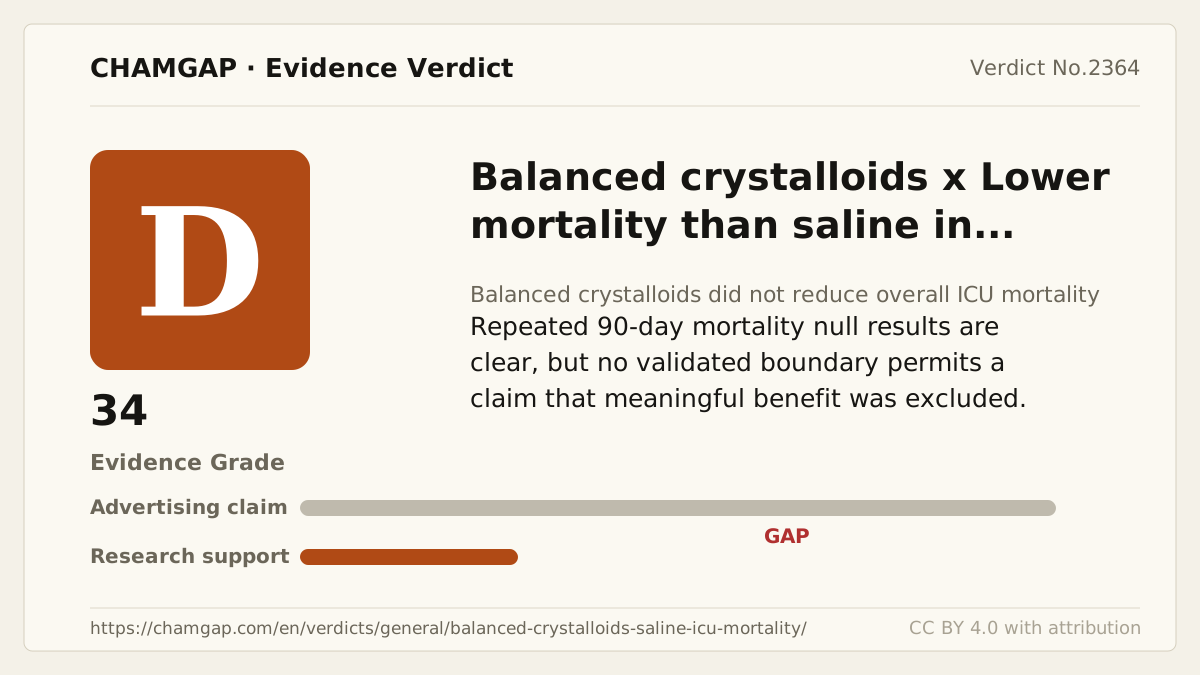
[Chamgap] Balanced crystalloids versus saline x ICU mortality — Evidence Grade D·34. 3 cited sources checked. Source: https://chamgap.com/en/verdicts/general/balanced-crystalloids-saline-icu-mortality/ · CC BY 4.0CC BY 4.0 — free to use with attribution; do not distort grades, numbers, or verdict meaning.
What this document does and does not do
Chamgap is an information source. It reports what research has and has not confirmed; it does not tell readers what to take or buy. That decision belongs to readers and, when needed, medical or legal professionals. This verdict reflects literature available up to the search date and may change as new research appears. Nothing here is medical advice.