
Dental recall interval,
does it really help with Maintenance of oral health and oral-health-related quality of life over four years?
research showsThe grade is D. INTERVAL randomized 2,372 adults. Four-year gingival-bleeding analysis included 416 participants in the 24-month-eligible stratum and 1,486 in the overall risk-based versus six-month comparison. In the eligible stratum, differences were -0.91 percentage points, 95% CI -5.02 to 3.20, for 24-month versus six-month recall and -0.98 points, -5.05 to 3.09, for risk-based versus six-month recall; OHIP-14 was also null. The 4.5-point value was a sample-size detection assumption, not a prespecified equivalence boundary. Substantial missingness and observed-data analysis give D with 30 points.
ads claimThe result cannot be marketed as proof that every adult needs a check-up only every two years. The 24-month arm was available only to patients dentists judged eligible, while risk-based recall could range from three to 24 months.
Useful facts when choosing a product
- This recall-interval question differs from fluoride toothpaste in verdict 701, A with 92 points; xylitol in verdict 748, C with 45 points; fissure sealants in verdict 1841, A with 86 points; supervised fluoride brushing in verdict 2515, C with 50 points; and the Hall technique in verdict 2712, B with 70 points.
- Water flossing in verdict 2359 is C with 46 points and mouthwash in verdict 2707 is C with 50 points; periodontal treatment in pregnancy in verdict 2226 is D with 34 points. Those concern tools, products, or preterm birth rather than adult recall timing.
- Twenty-four-month recall was tested only in the dentist-selected eligible stratum.
What the research actually shows
INTERVAL randomized 2,372 adults at 51 UK NHS dental practices in two strata. The 648 eligible for 24-month recall were assigned among risk-based, 24-month, and six-month recall; 1,724 ineligible participants were assigned to risk-based or six-month recall. Allocation used an automated central telephone service, and four-year clinical assessors were masked. The primary clinical analysis retained observed participants in assigned groups and used multiple imputation as a sensitivity analysis. However, only 416/648 eligible-stratum participants entered clinical analysis, 35.8% missing, and the primary analysis relied on observed completers. Participants knew their interval, leaving the subjective OHIP-14 primary endpoint unmasked. There was no early stopping. NIHR HTA provided public funding, and no company supplied an intervention item. Author disclosures reported Nigel Pitts consulting for Colgate and GSK, but did not report toothpaste-company support or trial materials for the recall intervention.
Why this is classified as D (30)
Both primary endpoints were null, but substantial missingness, observed-data analysis, and no validated equivalence boundary give D with 30 points.
Counterpoint. D does not mean six-month recall is proven superior. It means the trial did not identify a clear clinical difference while failing to provide a definitive equivalence boundary.
Rejudgment record. Cross-check applied — Cross-checks both primary endpoints, central allocation, masked assessment, observed-data intention-to-treat and imputation, missingness, NIHR funding, and author disclosures in the HTA report
| Endpoint | P | Patient-reported treatment goal - the symptom is the goal |
| Replication | R1 | Single confirmatory trial |
| Independence | I2 | Decisive evidence is publicly or non-profit funded |
| Effect size | E0 | Null |
| Precision | C0 | The confidence interval leaves room for benefit |
The scoring table and the verdict agree (D).
Sub-claim grades by effect
This ingredient is marketed for several effects. A single overall grade blends strong and weak claims together, so each effect is graded separately here. The overall grade reflects the strongest disconfirming or core claim.
| Effect (sub-claim) | Grade | Basis |
|---|---|---|
| Twenty-four-month versus six-month recall in eligible low-risk adults | D | Gingival bleeding and OHIP-14 were null, without a definitive equivalence boundary. |
| Risk-based versus six-month recall | D | The overall comparison also found no clinical or quality-of-life difference. |
Cross-check — Codex and Claude
Evidence Table
| Study | Design | Sample | Funding | Endpoint | Result | Weight |
|---|---|---|---|---|---|---|
| Study 1 | Pragmatic multicenter randomized trial at 51 UK practices with masked clinical assessment | 1,486 | NIHR HTA public funding; no company-supplied intervention item | Four-year proportion of sites bleeding on probing and OHIP-14 | Eligible-stratum 24-month versus six-month difference -0.91 points, 95% CI -5.02 to 3.20; risk-based versus six-month -0.98 points, -5.05 to 3.09; OHIP-14 null | Large publicly funded null trial with substantial missingness |
Receipt — 1 References
All 1 cited sources were verified for existence at the original page (as of 2026-08-18).
Reviewed and approved: Chamgap Editorial Team · Approval date: 2026-08-18 · Corrections: none
Cite this verdict
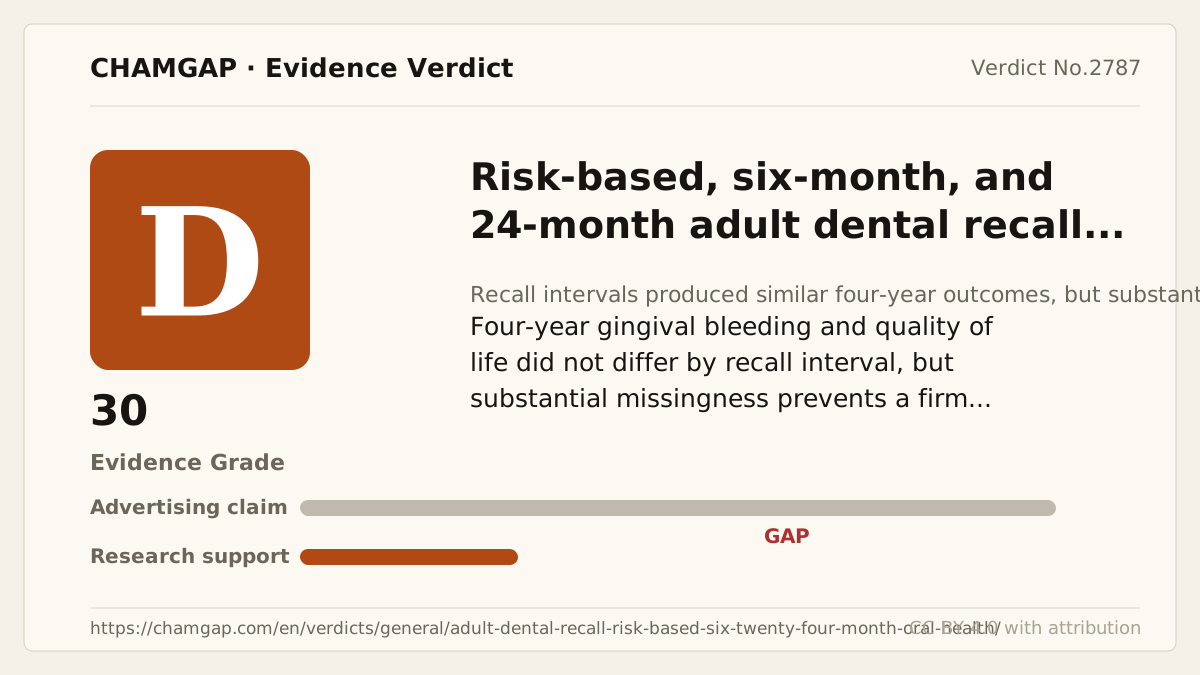
[Chamgap] Dental recall interval x adult oral health — Evidence Grade D·30. 1 cited sources checked. Source: https://chamgap.com/en/verdicts/general/adult-dental-recall-risk-based-six-twenty-four-month-oral-health/ · CC BY 4.0CC BY 4.0 — free to use with attribution; do not distort grades, numbers, or verdict meaning.
What this document does and does not do
Chamgap is an information source. It reports what research has and has not confirmed; it does not tell readers what to take or buy. That decision belongs to readers and, when needed, medical or legal professionals. This verdict reflects literature available up to the search date and may change as new research appears. Nothing here is medical advice.