
12-gene pharmacogenetic panel-guided prescribing,
does it really help with Reduction of causal, clinically relevant adverse drug reactions within 12 weeks of starting a new drug?
research showsThe grade is C with 56 points. In PREPARE's first prespecified hierarchical analysis, clinically relevant causal adverse reactions among 1,558 patients with an actionable genotype occurred in 152/725 (21.0%) with genotype-guided prescribing versus 231/833 (27.7%) with standard care, OR 0.70 (95% CI 0.54-0.91; P=0.0075). The complete-data analysis of 6,193 patients also found OR 0.70 (0.61-0.79), but open patient reporting adjudicated by unmasked local teams and a changed drug case-mix across crossover periods limit the grade to C.
ads claimAnalytical detection of 12 genes and clinical reduction of adverse reactions are separate claims. PREPARE tested a full workflow that returned results within seven days and changed drugs or doses under Dutch Pharmacogenetics Working Group guidance; a panel sold without clinical action cannot inherit the same effect.
Useful facts when choosing a product
- The workflow tested 50 variants in 12 pharmacogenes, adjusted eligible starting drugs or doses, and supplied a QR-based PGx passport.
- Of 6,944 allocated participants, 6,193 had complete data; loss to follow-up was 11.0% with genotype guidance and 7.9% with standard care.
- EU Horizon 2020 funded the trial; several authors disclosed industry relationships outside the submitted work.
What the research actually shows
PREPARE was an open implementation study across 18 hospitals, nine community health centers, and 28 pharmacies in seven European countries. Countries were cluster-assigned to one sequence and crossed to the other strategy after 19 months. A total of 6,944 participants were allocated, 3,342 versus 3,602, but 99 withdrew consent and 652 were lost, leaving complete data for 6,193, 2,923 versus 3,270. Prespecified gatekeeping tested 1,558 actionable-genotype patients first and the full population only after success. Registry and article agree on causal clinically relevant reactions within 12 weeks. However, unmasked subjective reporting and local adjudication plus changes in index drugs and recruiting centers across periods were avoidable limitations. EU Horizon 2020 funded the study and had no role in design, data, analysis, or writing.
Why this is classified as C (56)
A large publicly funded trial reduced actual adverse reactions, but unmasked subjective assessment and period-specific case-mix change create two avoidable limitations, giving C with 56 points.
Counterpoint. Effects for each drug-gene pair and transferability to other ancestries and health systems require separate evidence.
Rejudgment record. Cross-check applied — Cross-checked the PREPARE article, statistical analysis plan, and registry for hierarchical analyses, denominators, unmasked assessment, case-mix change, and funding
| Endpoint | H | Hard endpoint - actual events such as death |
| Replication | R1 | Single confirmatory trial |
| Independence | I2 | Decisive evidence is publicly or non-profit funded |
| Effect size | E+ | Meets the clinically important threshold |
The scoring table and the verdict agree (C).
Sub-claim grades by effect
This ingredient is marketed for several effects. A single overall grade blends strong and weak claims together, so each effect is graded separately here. The overall grade reflects the strongest disconfirming or core claim.
| Effect (sub-claim) | Grade | Basis |
|---|---|---|
| Twelve-gene panel-guided prescribing reduces 12-week adverse drug reactions | C | Both prespecified hierarchical analyses were positive, but assessment was unmasked and case-mix changed across periods. |
| Panel testing alone reduces adverse reactions without prescribing changes | ? | PREPARE tested result delivery and drug or dose adjustment, not testing alone. |
Cross-check — Codex and Claude
Evidence Table
| Study | Design | Sample | Funding | Endpoint | Result | Weight |
|---|---|---|---|---|---|---|
| Swen JJ, van der Wouden CH, Manson LE, Abdullah-Koolmees H, Blagec K, Blagus T, Böhringer S, Cambon-Thomsen A, Cecchin E, Cheung KC, Deneer VH, Dupui M, Ingelman-Sundberg M, Jonsson S, Joefield-Roka C, Just KS, Karlsson MO, Konta L, Koopmann R, Kriek M, Lehr T, Mitropoulou C, Rial-Sebbag E, Rollinson V, Roncato R, Samwald M, Schaeffeler E, Skokou M, Schwab M, Steinberger D, Stingl JC, Tremmel R, Turner RM, van Rhenen MH, Dávila Fajardo CL, Dolžan V, Patrinos GP, Pirmohamed M, Sunder-Plassmann G, Toffoli G, Guchelaar HJ, Ubiquitous Pharmacogenomics Consortium. 2023 PREPARE | Open-label cluster-randomized crossover implementation study in seven countries | 833 | Public EU Horizon 2020 Programme funding, grant 668353 | Causal, clinically relevant adverse drug reaction to the index drug within 12 weeks | Actionable genotype: 152/725 (21.0%) versus 231/833 (27.7%), OR 0.70 (95% CI 0.54-0.91), P=0.0075; all complete data: 628/2,923 (21.5%) versus 934/3,270 (28.6% in the abstract), OR 0.70 (0.61-0.79), P<0.0001 | Single large publicly funded trial; unmasked assessment and period-specific case-mix change |
Receipt — 1 References
All 1 cited sources were verified for existence at the original page (as of 2026-08-17).
Reviewed and approved: Chamgap Editorial Team · Approval date: 2026-08-17 · Corrections: none
Cite this verdict
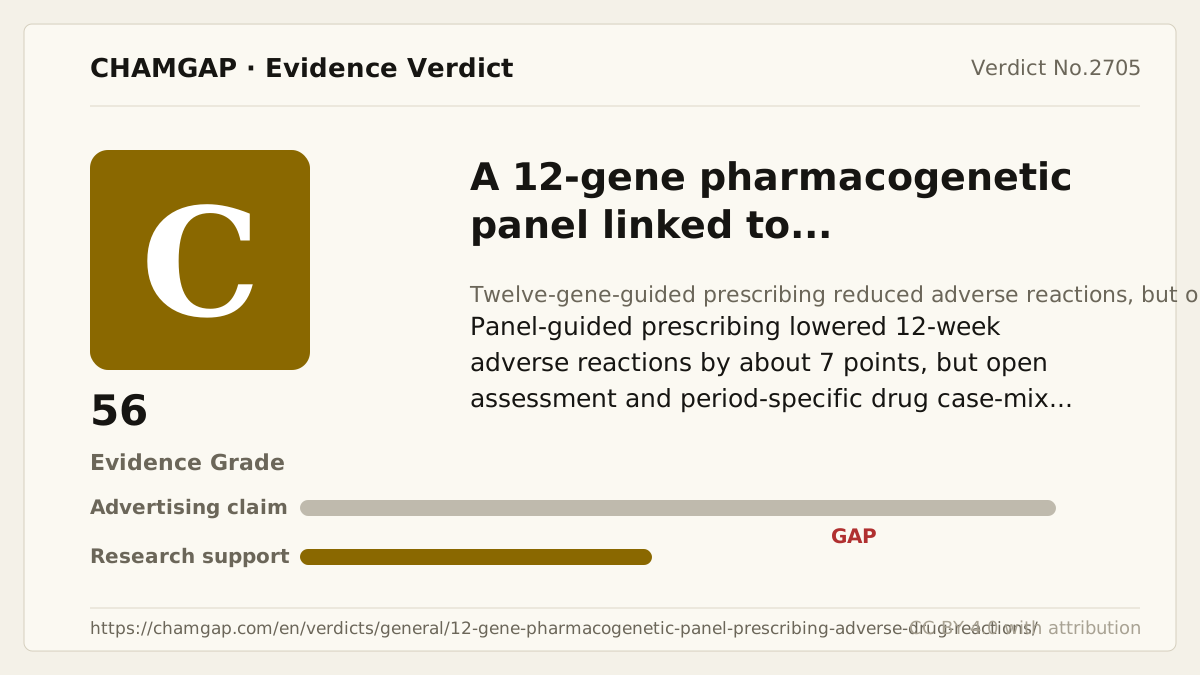
[Chamgap] 12-gene pharmacogenetic panel-guided prescribing x prevention of adverse drug reactions — Evidence Grade C·56. 1 cited sources checked. Source: https://chamgap.com/en/verdicts/general/12-gene-pharmacogenetic-panel-prescribing-adverse-drug-reactions/ · CC BY 4.0CC BY 4.0 — free to use with attribution; do not distort grades, numbers, or verdict meaning.
What this document does and does not do
Chamgap is an information source. It reports what research has and has not confirmed; it does not tell readers what to take or buy. That decision belongs to readers and, when needed, medical or legal professionals. This verdict reflects literature available up to the search date and may change as new research appears. Nothing here is medical advice.