
Yellow night-driving glasses,
does it really help with Faster pedestrian detection under headlight glare?
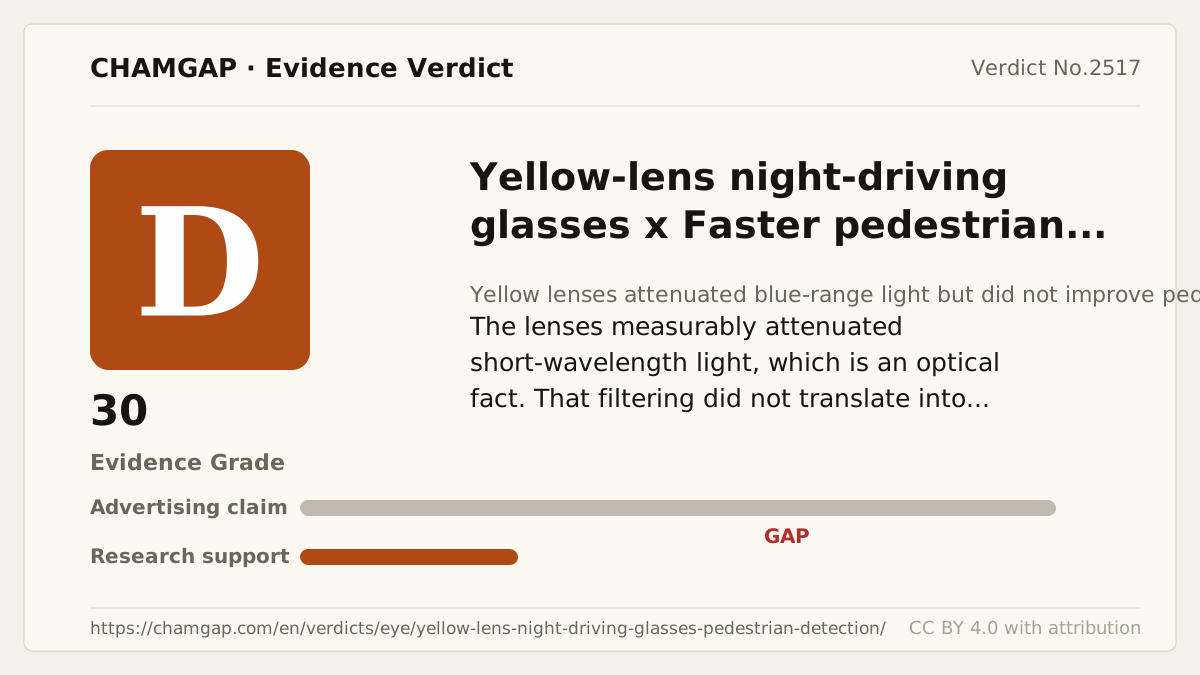
research showsThe grade is D. In a 22-person night-driving simulator experiment where each participant used three commercial yellow lenses and a clear lens, the overall lens main effect was F(1,63)=0.64, P=.42. Yellow lenses did not shorten response time in any condition. Public funding is reflected in D with 30 points.
ads claimMeasured attenuation of short-wavelength light cannot be rewritten as evidence that drivers see people sooner. Passing less light and improving night-detection performance are different claims.
Useful facts when choosing a product
- All three yellow lenses attenuated by more than half the short-wavelength blue range common in the simulated LED headlight spectrum.
- Three commercial yellow lenses were compared with a clear lens under glare-on and glare-off conditions.
- No duplicate verdict or reuse of this PMID or DOI was found.
What the research actually shows
This was not a parallel randomized clinical trial; each person repeatedly experienced lens conditions in a single-center experiment. Twelve younger participants completed the navy-shirt condition, while separate groups of six younger and four older participants completed the orange-shirt condition. The sample of 22 is a design limitation, and the reported omnibus F test did not provide a treatment-effect confidence interval capable of precisely excluding benefit. There was no trial registration.
Why this is classified as D (30)
Pedestrian response time was a simulator measure rather than an actual crash outcome, and the sole publicly funded study included only 22 people. The lens effect was null without a confidence interval that could precisely exclude benefit. Public funding is reflected in D with 30 points.
Counterpoint. Glare itself delayed responses, especially among older participants. The issue is not whether glare matters, but whether yellow lenses solve it; they did not here.
Rejudgment record. Cross-check applied — We cross-checked participant groups, repeated lens conditions, the main outcome and F tests, spectral transmission, and NIH support against the primary paper.
| Endpoint | P | Patient-reported treatment goal - the symptom is the goal |
| Replication | R1 | Single confirmatory trial |
| Independence | I2 | Decisive evidence is publicly or non-profit funded |
| Effect size | E0 | Null |
| Precision | CX | No pooled confidence interval could be confirmed |
The scoring table and the verdict agree (D).
Sub-claim grades by effect
This ingredient is marketed for several effects. A single overall grade blends strong and weak claims together, so each effect is graded separately here. The overall grade reflects the strongest disconfirming or core claim.
| Effect (sub-claim) | Grade | Basis |
|---|---|---|
| Yellow lenses speed nighttime pedestrian detection. | D | The overall lens effect among 22 participants was null. Short-wavelength attenuation is recorded separately as a physical fact in product_facts. |
Cross-check — Codex and Claude
Evidence Table
| Study | Design | Sample | Funding | Endpoint | Result | Weight |
|---|---|---|---|---|---|---|
| Study 1 | Single-center repeated-measures night-driving simulator experiment | 4 | NIH grants R01EY024075 and P30EY003790 | Time from pedestrian appearance to horn response | Overall lens main effect F(1,63)=0.64, P=.42; yellow lenses were not faster than clear lenses in any condition | Only small human experiment directly measuring the marketed performance claim |
| Study 2 | Spectral transmission and emission characterization of three products and the LED source | 3 | NIH grants R01EY024075 and P30EY003790 | Transmission in the short-wavelength blue range | All three yellow lenses attenuated more than half of the simulated LED headlight's short-wavelength range | Direct measurement supporting the accepted optical fact |
Receipt — 1 References
All 1 cited sources were verified for existence at the original page (as of 2026-08-14).
Reviewed and approved: Chamgap Editorial Team · Approval date: 2026-08-14 · Corrections: none
Cite this verdict
[Chamgap] Yellow night-driving glasses x improved pedestrian detection — Evidence Grade D·30. 1 cited sources checked. Source: https://chamgap.com/en/verdicts/eye/yellow-lens-night-driving-glasses-pedestrian-detection/ · CC BY 4.0CC BY 4.0 — free to use with attribution; do not distort grades, numbers, or verdict meaning.
What this document does and does not do
Chamgap is an information source. It reports what research has and has not confirmed; it does not tell readers what to take or buy. That decision belongs to readers and, when needed, medical or legal professionals. This verdict reflects literature available up to the search date and may change as new research appears. Nothing here is medical advice.