
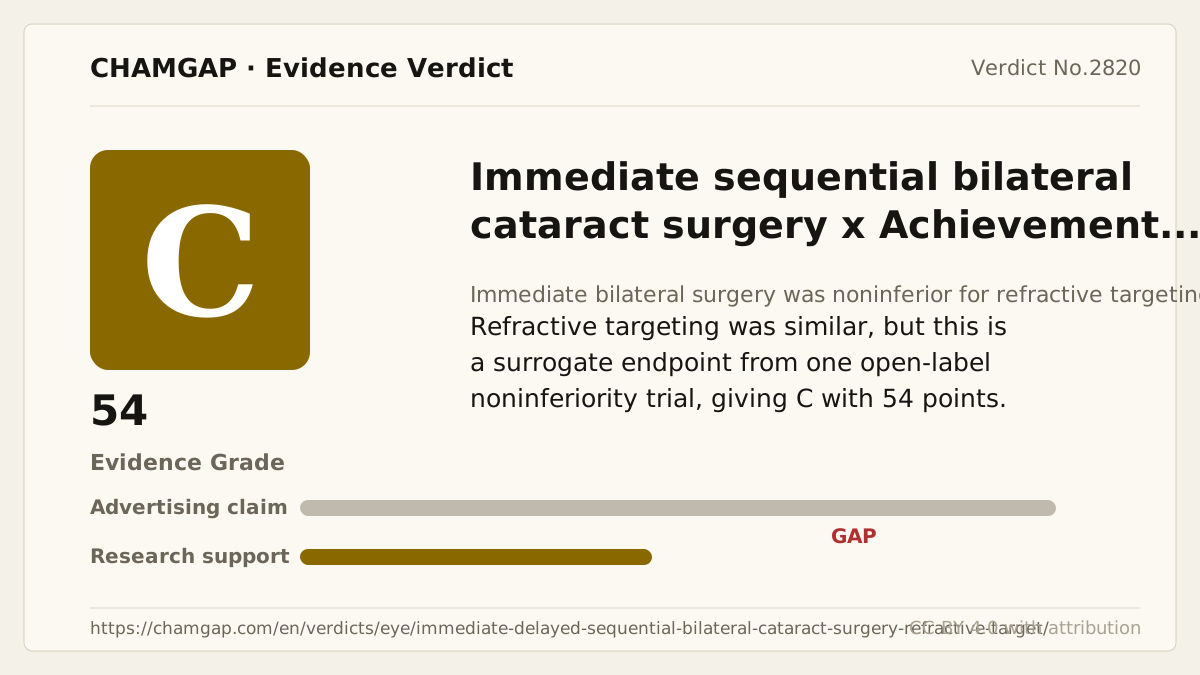
Immediate sequential bilateral cataract surgery,
does it really help with Achievement of refractive target versus delayed sequential surgery?
research showsThe grade is C with 54 points. In the modified ITT analysis, 404/417 (97%) versus 407/417 (98%) of second eyes were within 1.0 D of target; absolute difference -1 percentage point (90% CI -3 to 1), meeting the prespecified -5-point noninferiority margin.
ads claimVerdict 2813 is D with 34 points and asks which machine performs cataract surgery; this verdict asks when the two eyes are operated. Verdict 2336 is B with 76 points and asks about cataract surgery itself and dementia incidence. Verdict 1402 measured the clinical endpoints of falls and fractures over 12 months when first-eye surgery was expedited, whereas this verdict measures the surrogate of achieving a refractive target at four weeks according to bilateral-surgery timing. They ask different questions. These are technique, scheduling, and surgery-as-exposure questions.
Useful facts when choosing a product
- Immediate bilateral surgery uses separate sterile procedures for each eye on the same day.
- Societal cost was EUR403 lower per patient.
- Scheduling both eyes is a real choice affecting visits, recovery, and caregiver time.
What the research actually shows
Ten Dutch hospitals randomized 865 participants; modified ITT included 417 per group. The only avoidable design limitation was the open-label noninferiority design. Limitation name: open-label noninferiority design. Avoidability: possible - independent blinded outcome assessment and a superiority design could have been chosen. Refraction stabilizes about four weeks after cataract surgery, so the four-week assessment was appropriate for this endpoint and was not a short-duration limitation. A sham-surgery control was not viable. Avoidability: impossible - the surgery itself cannot be blinded. ZonMw and the Dutch Ophthalmological Society provided public/nonprofit funding; some authors reported industry consulting or lecture fees outside the submitted work.
Why this is classified as C (54)
Public funding is a strength, but a surrogate primary endpoint in one open-label noninferiority trial gives C with 54 points.
Counterpoint. Convenience and lower cost do not establish safety against extremely rare bilateral endophthalmitis.
Rejudgment record. Cross-check applied — Cross-checked BICAT-NL and registration for endpoint definition, -5-point margin, modified-ITT denominators, zero endophthalmitis, and public funding
| Endpoint | S | Surrogate marker - laboratory or imaging measures |
| Replication | R1 | Single confirmatory trial |
| Independence | I2 | Decisive evidence is publicly or non-profit funded |
| Effect size | E+ | Meets the clinically important threshold |
The scoring table and the verdict agree (C).
Sub-claim grades by effect
This ingredient is marketed for several effects. A single overall grade blends strong and weak claims together, so each effect is graded separately here. The overall grade reflects the strongest disconfirming or core claim.
| Effect (sub-claim) | Grade | Basis |
|---|---|---|
| Noninferior refractive target achievement | C | Absolute difference -1 point (90% CI -3 to 1) met the -5-point margin. |
| Safety against rare simultaneous bilateral endophthalmitis | ? | No event occurred, but the trial was underpowered to exclude this rare event. |
Cross-check — Codex and Claude
Evidence Table
| Study | Design | Sample | Funding | Endpoint | Result | Weight |
|---|---|---|---|---|---|---|
| Study 1 | 10-hospital open-label randomized noninferiority trial | 417 | ZonMw and Dutch Ophthalmological Society | Proportion of second eyes within 1.0 D of target four weeks after surgery | 404/417 (97%) versus 407/417 (98%); absolute -1 point (90% CI -3 to 1); margin -5 points | Pivotal single publicly funded noninferiority trial |
Receipt — 1 References
All 1 cited sources were verified for existence at the original page (as of 2026-08-18).
Reviewed and approved: Chamgap Editorial Team · Approval date: 2026-08-18 · Corrections: none
Cite this verdict
[Chamgap] Immediate versus Delayed Sequential Bilateral Cataract Surgery - Benefit — Evidence Grade C·54. 1 cited sources checked. Source: https://chamgap.com/en/verdicts/eye/immediate-delayed-sequential-bilateral-cataract-surgery-refractive-target/ · CC BY 4.0CC BY 4.0 — free to use with attribution; do not distort grades, numbers, or verdict meaning.
What this document does and does not do
Chamgap is an information source. It reports what research has and has not confirmed; it does not tell readers what to take or buy. That decision belongs to readers and, when needed, medical or legal professionals. This verdict reflects literature available up to the search date and may change as new research appears. Nothing here is medical advice.