
Direct delivery of free school eyeglasses,
does it really help with Improved end-of-year mathematics scores compared with prescription-only access?
research showsThe grade is C. In a cluster trial across 252 rural Chinese schools, directly providing free eyeglasses produced an end-of-year mathematics score 0.11 SD higher than giving prescriptions alone (95% CI 0.01 to 0.21). Mathematics achievement is a meaningful educational outcome in its own right, but no validated clinical threshold was found; under statistical effect-size conventions, 0.11 SD is below even the 0.2 small-effect benchmark.
ads claimThe trial did not show that eyeglasses increase intelligence. It showed a small difference in mathematics testing over one school year when access to correction was improved for students with uncorrected refractive error, many of whom needed to see a classroom blackboard.
Useful facts when choosing a product
- Students in the direct-delivery group received prescription-matched glasses in class; controls received prescriptions and information, with glasses supplied after study closeout.
- Observed eyeglass wear at closeout was 41% with direct provision and 26% in controls.
- Unlike other eyeglass and vision verdicts in the corpus, this verdict concerns end-of-year mathematics achievement rather than a visual-acuity chart.
What the research actually shows
The 252 schools were randomized, 84 each to direct provision, voucher, or prescription control, at a Stanford “central location.” The paper stated “Study staff were masked to group assignment,” did not disclose the overall design or explicit arm label to participants, and used multiple imputation in an “intention to treat” regression accounting for clustering and baseline mathematics score. However, one school was excluded after randomization because refraction found no eligible children, leaving 251 of 252 schools in the analysis. Of 3,177 eligible children, 3,052 (96.0%) completed follow-up. Prospectively registered ISRCTN03252665 and the paper both listed school performance as a principal outcome.
Why this is classified as C (46)
A large cluster-randomized trial found a statistically positive prespecified mathematics result, but the standardized difference was only 0.11 SD, funding was mixed, and one school was excluded after randomization, giving C with 46 points.
Counterpoint. Educational benefit may vary with the need for correction, blackboard use, actual wear, and local schooling conditions.
Rejudgment record. Cross-check applied — A large cluster-randomized trial found a positive prespecified school-performance result, but the 0.11-SD difference fell below the conventional small-effect range and one school was excluded after randomization
| Endpoint | P | Patient-reported treatment goal - the symptom is the goal |
| Replication | R1 | Single confirmatory trial |
| Independence | I1 | Mixed funding sources |
| Effect size | E~ | Statistically positive but below the threshold |
The scoring table and the verdict agree (C).
Sub-claim grades by effect
This ingredient is marketed for several effects. A single overall grade blends strong and weak claims together, so each effect is graded separately here. The overall grade reflects the strongest disconfirming or core claim.
| Effect (sub-claim) | Grade | Basis |
|---|---|---|
| Improved end-of-year mathematics score | C | The 0.11-SD difference was statistically positive but below the conventional small-effect range. |
| Increased observed eyeglass wear at school | B | Observed wear at closeout was 41% versus 26%. |
Cross-check — Codex and Claude
Evidence Table
| Study | Design | Sample | Funding | Endpoint | Result | Weight |
|---|---|---|---|---|---|---|
| Study 1 | Three-arm assessor-masked cluster-randomized trial across 252 schools | 3,052 | Mixed funding from OneSight, Luxottica-China, Essilor-China, CLSA, Charity Aid Foundation, and an anonymous donor | End-of-year standardized mathematics score adjusted for baseline score | Direct provision versus control differed by 0.11 SD (95% CI 0.01 to 0.21); adjusted model 0.10 SD (95% CI 0.002 to 0.19). | Pivotal single cluster-randomized trial |
Receipt — 1 References
All 1 cited sources were verified for existence at the original page (as of 2026-08-15).
Reviewed and approved: Chamgap Editorial Team · Approval date: 2026-08-15 · Corrections: none
Cite this verdict
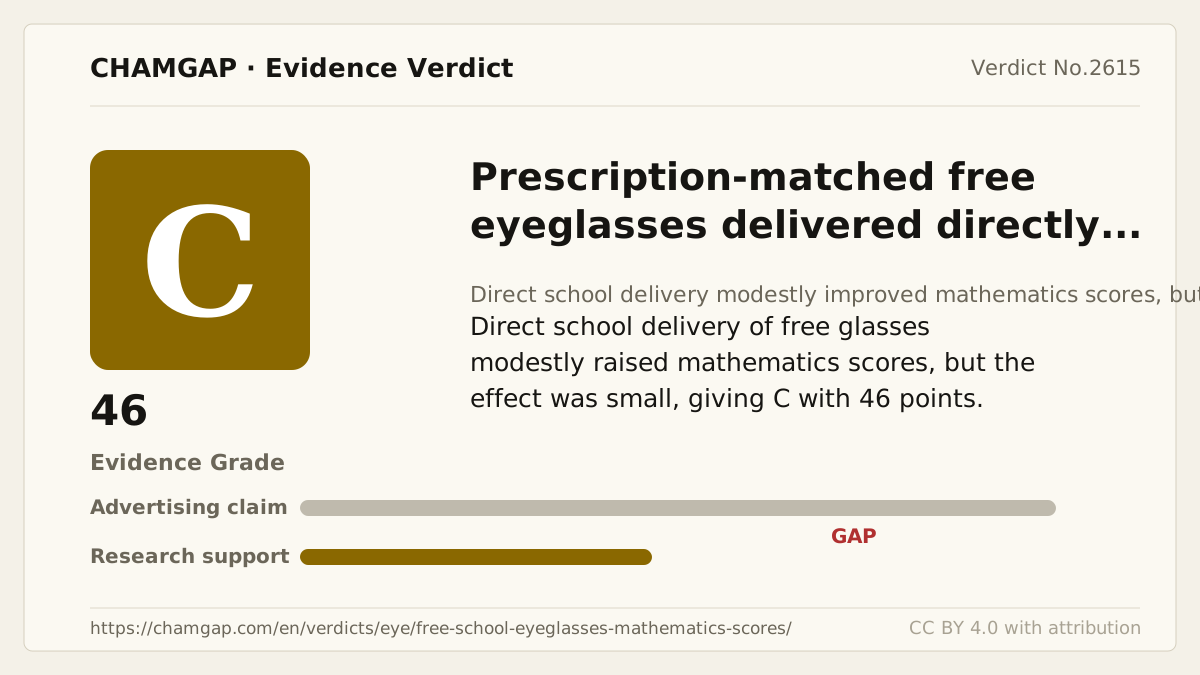
[Chamgap] Direct delivery of free school eyeglasses x mathematics scores — Evidence Grade C·46. 1 cited sources checked. Source: https://chamgap.com/en/verdicts/eye/free-school-eyeglasses-mathematics-scores/ · CC BY 4.0CC BY 4.0 — free to use with attribution; do not distort grades, numbers, or verdict meaning.
What this document does and does not do
Chamgap is an information source. It reports what research has and has not confirmed; it does not tell readers what to take or buy. That decision belongs to readers and, when needed, medical or legal professionals. This verdict reflects literature available up to the search date and may change as new research appears. Nothing here is medical advice.