
Femtosecond laser-assisted cataract surgery,
does it really help with Superior three-month uncorrected distance visual acuity versus phacoemulsification?
research showsThe grade is D. FACT found essentially identical three-month uncorrected distance visual acuity with FLACS and standard phacoemulsification. The adjusted difference was -0.01 logMAR (95% CI -0.05 to 0.03), crossing zero and showing no superiority. FLACS did satisfy the 0.1 logMAR noninferiority margin.
ads claimUK trial costs were GBP 167.62 higher per patient with FLACS, with a QALY difference of 0.001. Verdict 2820 is C with 54 points and asks when to operate on the two eyes, whereas this verdict asks which machine to use. Verdict 2336 is B with 76 points and addresses cataract surgery itself in relation to dementia, another question.
Useful facts when choosing a product
- The adjusted three-month UDVA difference was -0.01 logMAR.
- Mean cost was GBP 167.62 higher per patient with FLACS in the trial analysis.
- The femtosecond laser was funded through Moorfields Eye Charity grants.
What the research actually shows
FACT randomized 785 participants, 392 versus 393. A secure online service provided computer-generated identifiers and allocations. Participant and surgeon masking was impossible, but all follow-up was performed by masked optometrists. The primary model adjusted baseline factors and handled missing outcomes with multiple imputation, with per-protocol and complete-case support. The named limitation is noninferiority design. NIHR HTA provided public funding, and Moorfields Eye Charity grants GR000233 and GR000449 funded the endothelial cell counter and femtosecond laser used. This was charity support, not manufacturer provision, and the authors declared no proprietary or commercial interest.
Why this is classified as D (34)
A publicly and charitably funded 785-participant trial used a patient-centered vision outcome, but superiority crossed zero and remained within half the prespecified 0.1 logMAR threshold. A single noninferiority trial gives D with 34 points.
Counterpoint. D does not mean FLACS worsens vision; it means superior uncorrected-distance vision was not shown and a clinically important advantage was excluded.
Rejudgment record. Article, HTA, and registry cross-check — Patient-centered UDVA, -0.01 logMAR difference, prespecified 0.1 logMAR threshold, public-charity funding, and noninferiority design
| Endpoint | P | Patient-reported treatment goal - the symptom is the goal |
| Replication | R1 | Single confirmatory trial |
| Independence | I2 | Decisive evidence is publicly or non-profit funded |
| Effect size | E0 | Null |
| Precision | C1 | The confidence interval excludes meaningful benefit |
The scoring table and the verdict agree (D).
Sub-claim grades by effect
This ingredient is marketed for several effects. A single overall grade blends strong and weak claims together, so each effect is graded separately here. The overall grade reflects the strongest disconfirming or core claim.
| Effect (sub-claim) | Grade | Basis |
|---|---|---|
| Superior three-month uncorrected distance visual acuity | D | The -0.01 logMAR interval crossed zero and allowed less than the 0.1 logMAR threshold of benefit. |
| Visual noninferiority versus standard surgery | B | The 95% CI did not cross the prespecified 0.1 logMAR inferiority margin. |
Cross-check — Codex and Claude
Evidence Table
| Study | Design | Sample | Funding | Endpoint | Result | Weight |
|---|---|---|---|---|---|---|
| Study 1 | Multicenter outcome-masked randomized noninferiority trial | 317 | Public NIHR HTA funding; Moorfields Eye Charity funded the endothelial counter and femtosecond laser used; no proprietary or commercial interests declared | Three-month uncorrected distance visual acuity in the study eye using a 4 m ETDRS logMAR chart | Adjusted difference -0.01 logMAR (95% CI -0.05 to 0.03); prespecified noninferiority margin 0.1 logMAR | Public-charity funded patient-centered vision evidence with null superiority |
Receipt — 1 References
All 1 cited sources were verified for existence at the original page (as of 2026-08-18).
Reviewed and approved: Chamgap Editorial Team · Approval date: 2026-08-18 · Corrections: none
Cite this verdict
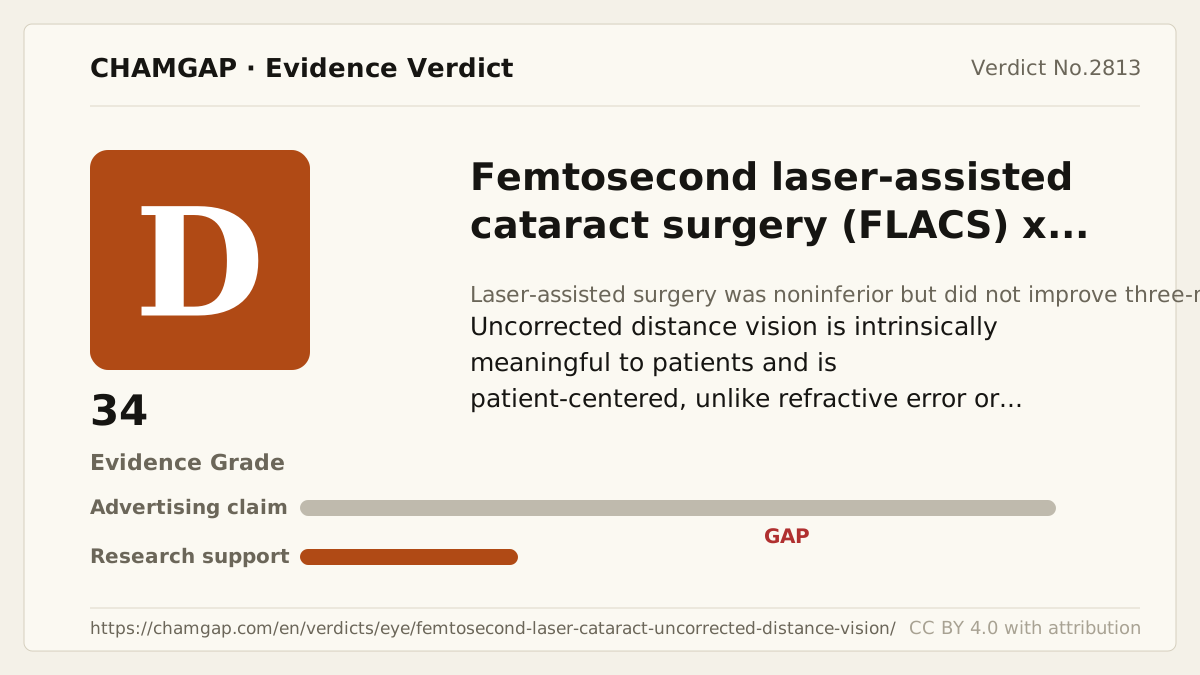
[Chamgap] Femtosecond Laser-Assisted Cataract Surgery Versus Phacoemulsification - Benefit — Evidence Grade D·34. 1 cited sources checked. Source: https://chamgap.com/en/verdicts/eye/femtosecond-laser-cataract-uncorrected-distance-vision/ · CC BY 4.0CC BY 4.0 — free to use with attribution; do not distort grades, numbers, or verdict meaning.
What this document does and does not do
Chamgap is an information source. It reports what research has and has not confirmed; it does not tell readers what to take or buy. That decision belongs to readers and, when needed, medical or legal professionals. This verdict reflects literature available up to the search date and may change as new research appears. Nothing here is medical advice.