
Eyelid cleansing wipes,
does it really help with Reduction of blepharitis-associated ocular symptoms?
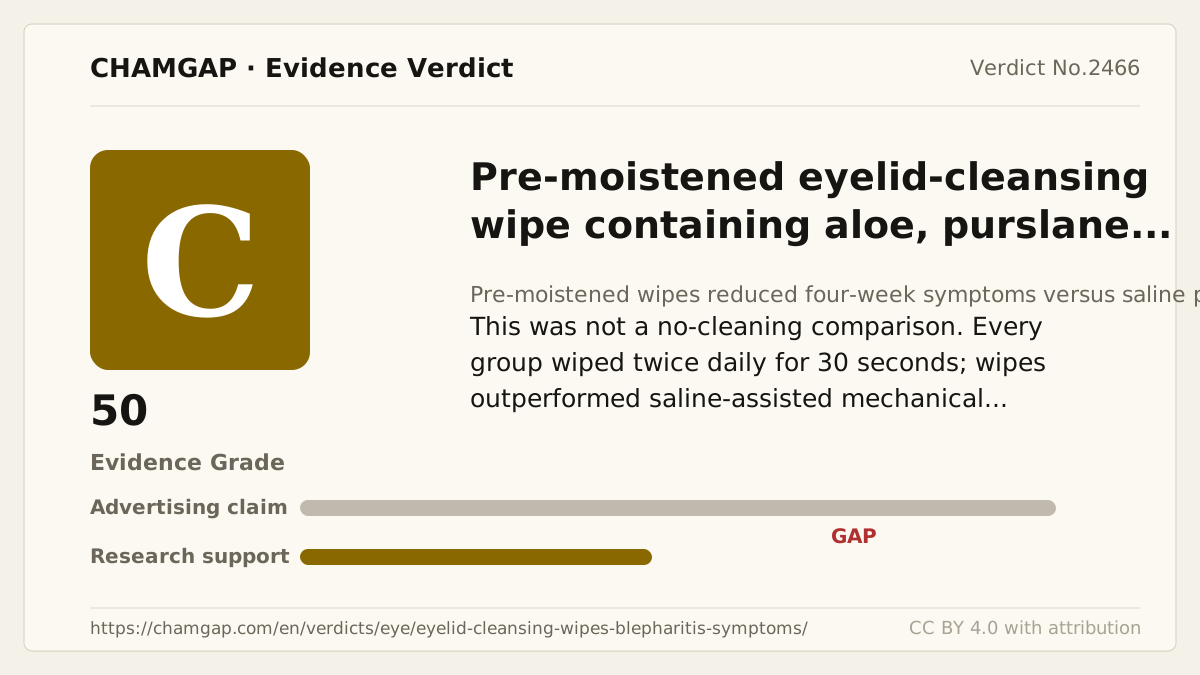
research showsThe grade is C. In a 72-participant single-center trial, baseline-adjusted Week 4 symptom VAS means were 27.47 with wipes and 40.83 with an identical pad moistened with 0.9% saline, a difference of -13.35 points (95% CI -21.51 to -5.20). The wipe was not superior to a pad moistened with 0.01% hypochlorous acid: -5.68 (-13.13 to 1.76).
ads claimIt is not established that eyelid cleansers sold in Korea are compositionally identical to Aishiyoujia/EYESU+. A generic product name is insufficient to transfer the result.
Useful facts when choosing a product
- The study wipe contained purified water, aloe leaf juice, purslane extract, glycerine, propylene glycol, panthenol, polysorbate 20, sodium lauroyl sarcosinate, butylene glycol, and p-hydroxyacetophenone.
- Verdict 2412 is D with 28 points and concerns weekly 50% in-office plus daily 10% home tea-tree-oil cleansing for Demodex blepharitis. This is a different intervention from a different evidence source.
- Warm compresses and other active blepharitis therapies were prohibited.
What the research actually shows
Shi et al. randomized 72 adults 1:1:1 to a pre-moistened wipe, a matched pad sprayed four times with 0.01% hypochlorous acid, or a matched pad sprayed four times with sterile 0.9% saline. All groups wiped the closed lid margin for 30 seconds twice daily for 28 days. The operational full analysis set was 21/22/21, while observed Week 4 VAS counts were 21/20/18. Unadjusted Week 4 means were 29.36±13.79, 34.20±3.59, and 37.47±18.21. Registration ChiCTR2500101040 was cited, but its public record could not be opened to verify endpoints, comparators, and analysis. The manuscript PDF states, “The authors received no specific funding for this work,” while the publisher page lists three Chinese public grants. Product provision was not reported.
Why this is classified as C (50)
The patient-centered primary symptom endpoint favored wipes over active saline cleansing, but one small short trial with unmasked subjective reporting and incomplete randomized-set inclusion supports C with 50 points.
Counterpoint. C does not mean no effect; it recognizes short-term symptom benefit while noting no established superiority over hypochlorous acid and no confirmed durability.
Rejudgment record. Cross-check applied — Baseline-adjusted primary symptom results from an active-cleaning three-arm trial, tempered by missing randomized participants, small size, and short follow-up
| Endpoint | P | Patient-reported treatment goal - the symptom is the goal |
| Replication | R1 | Single confirmatory trial |
| Independence | I1 | Mixed funding sources |
| Effect size | E+ | Meets the clinically important threshold |
The scoring table and the verdict agree (C).
Sub-claim grades by effect
This ingredient is marketed for several effects. A single overall grade blends strong and weak claims together, so each effect is graded separately here. The overall grade reflects the strongest disconfirming or core claim.
| Effect (sub-claim) | Grade | Basis |
|---|---|---|
| Four-week symptom reduction versus saline-assisted mechanical cleansing | C | The adjusted difference was significant at -13.35 points. |
| Symptom reduction versus hypochlorous-acid-assisted cleansing | D | The confidence interval crossed zero. |
Cross-check — Codex and Claude
Evidence Table
| Study | Design | Sample | Funding | Endpoint | Result | Weight |
|---|---|---|---|---|---|---|
| Study 1 | Single-center assessor-masked three-arm randomized trial | 59 | PDF: “The authors received no specific funding for this work”; publisher page: three Chinese public grants; product provision not reported | Primary: Week 4 eye-specific mean of eight VAS symptom items; secondary: OSDI and lid/ocular-surface signs | Adjusted VAS 27.47 vs 33.16 vs 40.83; wipe-saline -13.35 (95% CI -21.51 to -5.20), wipe-hypochlorous acid -5.68 (-13.13 to 1.76) | Only direct confirmatory evidence |
Receipt — 2 References
All 2 cited sources were verified for existence at the original page (as of 2026-08-08).
Reviewed and approved: Chamgap Editorial Team · Approval date: 2026-08-08 · Corrections: none
Cite this verdict
[Chamgap] Eyelid cleansing wipes x reduced blepharitis symptoms — Evidence Grade C·50. 2 cited sources checked. Source: https://chamgap.com/en/verdicts/eye/eyelid-cleansing-wipes-blepharitis-symptoms/ · CC BY 4.0CC BY 4.0 — free to use with attribution; do not distort grades, numbers, or verdict meaning.
What this document does and does not do
Chamgap is an information source. It reports what research has and has not confirmed; it does not tell readers what to take or buy. That decision belongs to readers and, when needed, medical or legal professionals. This verdict reflects literature available up to the search date and may change as new research appears. Nothing here is medical advice.