
Tofersen,
does it really help with Change in the 28-week ALSFRS-R functional score in SOD1 amyotrophic lateral sclerosis?
research showsThe grade is D. In VALOR's faster-progression primary analysis, 28-week ALSFRS-R change was -6.98 with tofersen and -8.14 with placebo, adjusted difference +1.2 points (95% CI -3.2 to 5.5), P=0.97. This was null, but the interval still allows tofersen to be 3.2 points worse or 5.5 points better, so benefit was not excluded.
ads claimIt is inaccurate to rewrite 'a biomarker fell and supported approval' as '28-week function improved.' Korean clinical data estimate ALS prevalence at about 3.43 per 100,000, and SOD1 mutations are only a subset. Genetic testing, repeated lumbar puncture, and orphan-drug access pathways constrain real-world access.
Useful facts when choosing a product
- Tofersen is an antisense oligonucleotide targeting SOD1 mRNA and is delivered intrathecally by lumbar puncture.
- VALOR used 24 weeks of dosing with the primary assessment at Week 28.
- Lumbar-puncture adverse events were common, and neurologic serious adverse events occurred in 7% of tofersen recipients.
What the research actually shows
VALOR assigned 108 patients with SOD1 ALS across 32 sites in 10 countries 2:1 to tofersen 72 or placebo 36 in a double-blind phase 3 trial. Allocation used the protocol's centralized interactive response technology, and the paper states, 'Randomization was stratified according to the use or nonuse of edaravone, riluzole, or both at baseline,' along with faster-progression prognostic criteria. The prespecified primary population contained 60 faster-progressing participants, 39/21, and the full 108-patient analysis also showed no clinical-endpoint improvement. Defect name: Small study in a rare genetic subtype. Listed item: Small study, total under 200 - actual VALOR randomized total 108. Avoidability: Avoidable - more international sites and a longer recruitment period could have enrolled at least 200. Substantial attrition (>=15%): actual Week 28 attrition was below the threshold, not applicable. Short study under 12 weeks: actual duration 28 weeks, not applicable. Biogen sponsored the trial, supplied study treatment, oversaw operations and statistics, provided medical-writing support, and employed multiple authors. Verdict 1213 is B with 73 points and concerns a drug used across ALS with delayed death or tracheostomy; this verdict concerns a gene-targeted drug restricted to SOD1 mutations and measures 28-week function.
Why this is classified as D (28)
The patient-centered 28-week functional primary endpoint was null in one 108-person manufacturer-funded trial, while its confidence interval did not exclude benefit, giving D with 28 points.
Counterpoint. Null does not mean no effect was proven. The interval extended to a 5.5-point benefit, leaving the need for a more precise functional trial.
Rejudgment record. Cross-check applied — Cross-checked VALOR's 108-person centralized randomized double-blind design, null 28-week ALSFRS-R result in the faster-progression population, confidence interval, Biogen role, and the separate basis for FDA accelerated approval
| Endpoint | P | Patient-reported treatment goal - the symptom is the goal |
| Replication | R1 | Single confirmatory trial |
| Independence | I0 | Evidence comes only from manufacturer studies |
| Effect size | E0 | Null |
| Precision | C0 | The confidence interval leaves room for benefit |
The scoring table and the verdict agree (D).
Sub-claim grades by effect
This ingredient is marketed for several effects. A single overall grade blends strong and weak claims together, so each effect is graded separately here. The overall grade reflects the strongest disconfirming or core claim.
| Effect (sub-claim) | Grade | Basis |
|---|---|---|
| Improvement in 28-week ALSFRS-R function | D | The +1.2-point difference (95% CI -3.2 to 5.5), P=0.97, was null without excluding benefit. |
| Reduction in SOD1 and neurofilament biomarkers | C | Biomarkers fell, but this surrogate result is separate from functional improvement. |
Cross-check — Codex and Claude
Evidence Table
| Study | Design | Sample | Funding | Endpoint | Result | Weight |
|---|---|---|---|---|---|---|
| Study 1 | Multinational randomized double-blind placebo-controlled phase 3 trial | 21 | Biogen sponsored, supplied treatment, supported operations, statistics, and medical writing; employee authors included | Change from baseline to Week 28 in total ALSFRS-R score in faster-progressing participants | -6.98 versus -8.14 points, adjusted difference +1.2 (95% CI -3.2 to 5.5), P=0.97; null without excluding benefit | Manufacturer-funded single small trial with a null patient-centered primary endpoint |
Receipt — 2 References
All 2 cited sources were verified for existence at the original page (as of 2026-08-18).
Reviewed and approved: Chamgap Editorial Team · Approval date: 2026-08-18 · Corrections: none
Cite this verdict
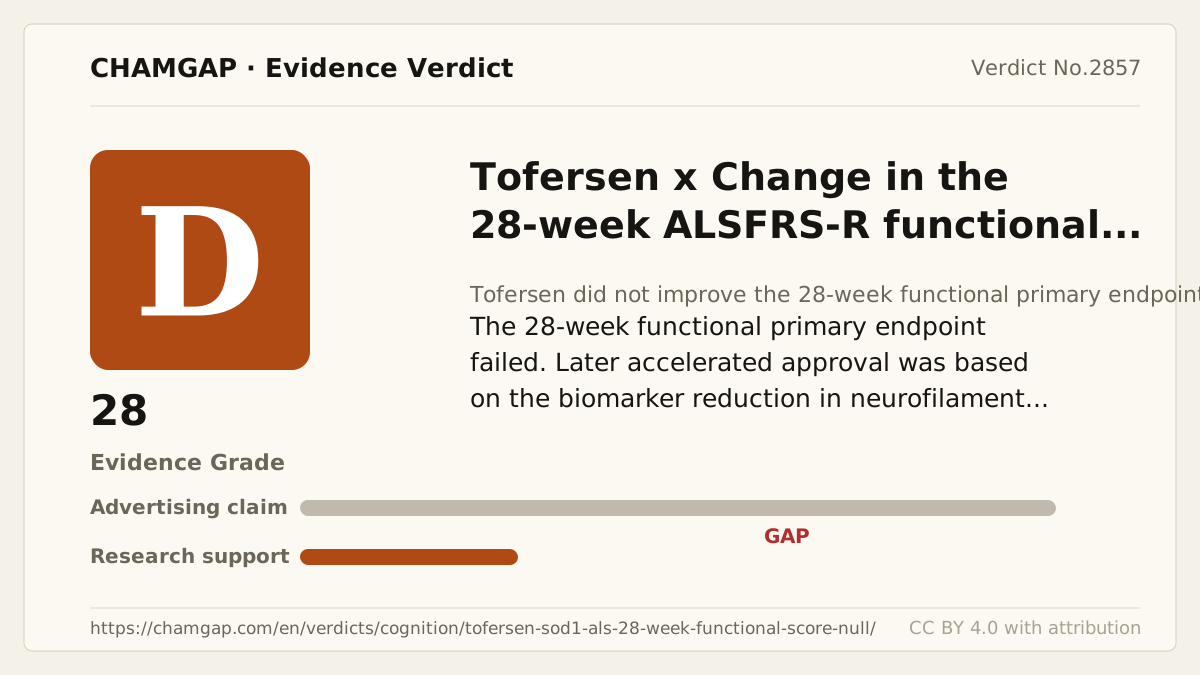
[Chamgap] Tofersen Is Ineffective on the 28-Week Functional Score in SOD1 Amyotrophic Lateral Sclerosis — Evidence Grade D·28. 2 cited sources checked. Source: https://chamgap.com/en/verdicts/cognition/tofersen-sod1-als-28-week-functional-score-null/ · CC BY 4.0CC BY 4.0 — free to use with attribution; do not distort grades, numbers, or verdict meaning.
What this document does and does not do
Chamgap is an information source. It reports what research has and has not confirmed; it does not tell readers what to take or buy. That decision belongs to readers and, when needed, medical or legal professionals. This verdict reflects literature available up to the search date and may change as new research appears. Nothing here is medical advice.