
Oral succimer chelation, also known as DMSA,
does it really help with Improved cognitive, behavioral, and neuropsychological development in children with blood lead levels of 20 to 44 µg/dL?
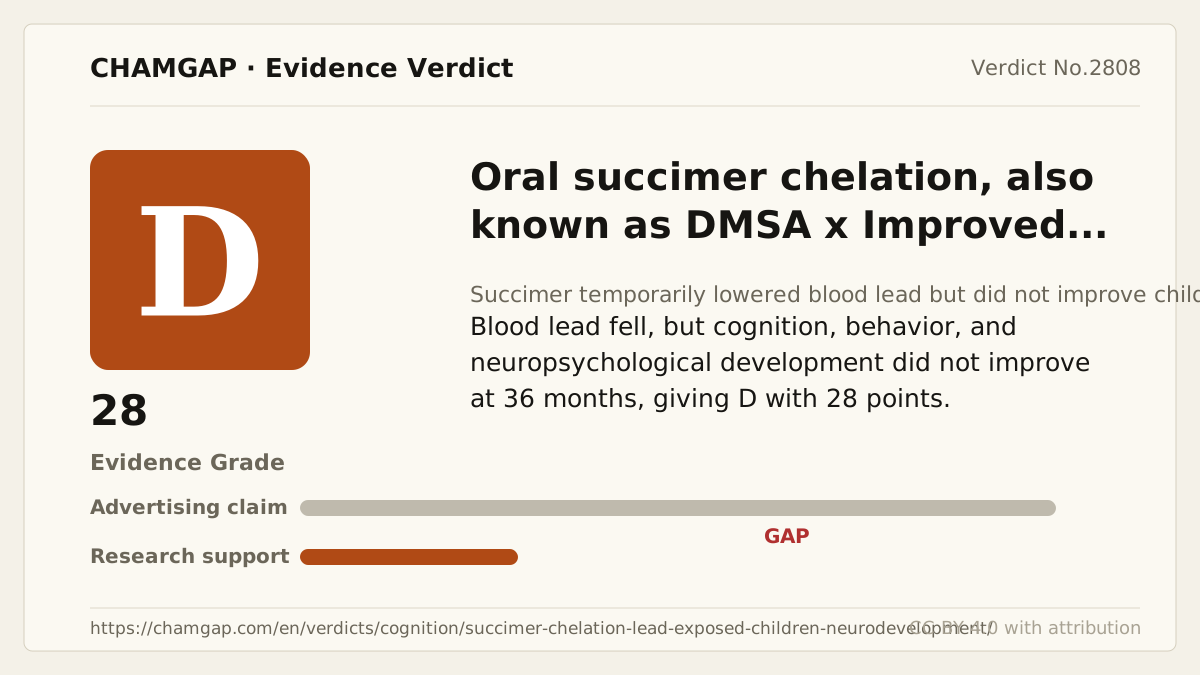
research showsThe grade is D. TLC randomized 780 children aged 12 to 33 months to succimer, 396, or placebo, 384, and followed development for 36 months. Mean blood lead during the first 6 months was 4.5 µg/dL lower (95% CI 3.7 to 5.3), but adjusted full-scale IQ was 1.1 points lower with succimer; the succimer-minus-placebo difference was -1.1 (95% CI -2.6 to 0.5). A biomarker improvement without developmental benefit in one trial gives D with 28 points.
ads claimChelation procedures and supplements are marketed in Korea using heavy-metal "detox" language, but lowering a blood measurement and reversing a child's cognitive injury are different claims. Corpus verdicts on liver "detox" address different liver-function, enzyme, or symptom questions and were not combined with this pediatric neurodevelopment verdict.
Useful facts when choosing a product
- Succimer temporarily lowered blood lead, followed by rebound, and most of the group difference disappeared by one year.
- Scalp rash occurred in 3.5% versus 1.3%; trauma was reported in 15% versus 10%, with five trauma admissions versus none.
- The paper reported 0.25 cm less linear growth at 12 months and 0.35 cm less at 34 months.
What the research actually shows
TLC randomized 780 children across four US clinical areas from 1994 to 1997, used up to three 26-day treatment courses, and followed them for 36 months. Full-scale IQ was measured or prespecifiedly imputed for 745/780 (96%), and analyses followed intention to treat. Testing psychologists were masked and active and placebo capsules looked identical. However, the article reported stratification by center, body-surface area, blood lead, and language without describing how allocation concealment was implemented, counted as one reporting and design limitation. NIEHS funded the trial through contracts and agreements in cooperation with the NIH Office of Research on Minority Health and CDC, while McNeil Consumer Products provided succimer and placebo capsules.
Why this is classified as D (28)
A large double-blind trial found no benefit on directly important development, but no independent repeated trial or validated exclusion threshold exists and allocation-concealment implementation was not reported, giving D with 28 points.
Counterpoint. This applies to children aged 12 to 33 months with blood lead of 20 to 44 µg/dL. It does not negate treatment decisions for symptomatic poisoning, levels of 45 µg/dL or higher, or poisoning by other metals.
Rejudgment record. Cross-check applied — Separates temporary blood-lead reduction from null 36-month development and does not promote a sample-size assumption into an exclusion threshold
| Endpoint | P | Patient-reported treatment goal - the symptom is the goal |
| Replication | R1 | Single confirmatory trial |
| Independence | I1 | Mixed funding sources |
| Effect size | E0 | Null |
| Precision | C0 | The confidence interval leaves room for benefit |
The scoring table and the verdict agree (D).
Sub-claim grades by effect
This ingredient is marketed for several effects. A single overall grade blends strong and weak claims together, so each effect is graded separately here. The overall grade reflects the strongest disconfirming or core claim.
| Effect (sub-claim) | Grade | Basis |
|---|---|---|
| Improved cognition at 36 months | D | Adjusted full-scale IQ differed by -1.1 points (95% CI -2.6 to 0.5). |
| Lower blood lead | C | Mean blood lead was 4.5 µg/dL lower over 6 months, followed by rebound. |
Cross-check — Codex and Claude
Evidence Table
| Study | Design | Sample | Funding | Endpoint | Result | Weight |
|---|---|---|---|---|---|---|
| Study 1 | US multicenter double-blind placebo-controlled randomized trial | 96 | Public support from NIEHS, NIH Office of Research on Minority Health, and CDC, with study drug and placebo provided by McNeil Consumer Products | 36-month WPPSI-R full-scale IQ, NEPSY domains, and parent-rated behavioral index | Adjusted full-scale IQ succimer minus placebo -1.1 points (95% CI -2.6 to 0.5); mean blood lead during the first 6 months was 4.5 µg/dL lower (95% CI 3.7 to 5.3) | Pivotal RCT separating biomarker improvement from null developmental outcomes |
Receipt — 2 References
All 2 cited sources were verified for existence at the original page (as of 2026-08-18).
Reviewed and approved: Chamgap Editorial Team · Approval date: 2026-08-18 · Corrections: none
Cite this verdict
[Chamgap] The Effect of Chelation Therapy With Succimer on Neuropsychological Development in Children Exposed to Lead - Null — Evidence Grade D·28. 2 cited sources checked. Source: https://chamgap.com/en/verdicts/cognition/succimer-chelation-lead-exposed-children-neurodevelopment/ · CC BY 4.0CC BY 4.0 — free to use with attribution; do not distort grades, numbers, or verdict meaning.
What this document does and does not do
Chamgap is an information source. It reports what research has and has not confirmed; it does not tell readers what to take or buy. That decision belongs to readers and, when needed, medical or legal professionals. This verdict reflects literature available up to the search date and may change as new research appears. Nothing here is medical advice.