
Sauna-bathing frequency,
does it really help with Reduced incidence of dementia?
research showsThe grade is C with 54 points. Two Finnish prospective cohorts associated frequent sauna use with less incident dementia, but neither was randomized. Neither applied a prespecified exclusion window before diagnosis to address reverse causation, and healthy-user bias remains plausible.
ads claimAn association must not be restated as prevention. Early cognitive decline may reduce sauna use, and activity, health, sleep, or social participation may explain part of the difference.
Useful facts when choosing a product
- The Laukkanen study was a population-based prospective cohort, not a randomized trial.
- Laukkanen reported Finnish Foundation for Cardiovascular Research support; separate study funding was not identified in the Knekt article. The author teams did not overlap.
- Verdict 1237 is D with 30 points for mortality and healthspan, verdict 1378 is D with 26 points for sauna-suit weight loss, and verdict 1459 is D with 27 points for far-infrared sauna and arthritis symptoms. This verdict addresses incident dementia instead.
What the research actually shows
Laukkanen et al. followed 2,315 Finnish men aged 42 to 60 for a median 20.7 years. Dementia occurred in 59/601 (9.8%) weekly users and 8/201 (4.0%) users bathing four to seven times weekly; adjusted HR 0.34, 95% CI 0.16 to 0.71. Adjustments included age, BMI, systolic pressure, LDL, smoking, alcohol, myocardial infarction, type 2 diabetes, resting heart rate, with additional physical activity and socioeconomic status, but no prediagnosis lag exclusion. Knekt et al. followed 13,994 Finnish men and women for 39 years. Dementia occurred in 660/4,724 (14.0%) bathing zero to four times monthly and 178/1,896 (9.4%) bathing nine to twelve times monthly; full-follow-up HR 0.81, 95% CI 0.69 to 0.97, and first-20-year HR 0.47, 0.25 to 0.88. The latter interval analysis was not a prediagnosis exclusion analysis.
Why this is classified as C (54)
Positive associations concern clinical dementia events, but lack of randomization and unresolved reverse-causation and healthy-user bias limit the verdict to C with 54 points.
Counterpoint. Enjoying sauna and prescribing it as dementia prevention are different decisions.
Rejudgment record. Cross-check applied — Two prospective cohorts were positive for dementia incidence, but neither used a prediagnosis lag and healthy-user bias remains
| Endpoint | H | Hard endpoint - actual events such as death |
| Replication | R1 | Single confirmatory trial |
| Independence | I1 | Mixed funding sources |
| Effect size | E+ | Meets the clinically important threshold |
The scoring table and the verdict agree (C).
Sub-claim grades by effect
This ingredient is marketed for several effects. A single overall grade blends strong and weak claims together, so each effect is graded separately here. The overall grade reflects the strongest disconfirming or core claim.
| Effect (sub-claim) | Grade | Basis |
|---|---|---|
| Reduced incident dementia | C | Two prospective associations do not establish a causal effect. |
Cross-check — Codex and Claude
Evidence Table
| Study | Design | Sample | Funding | Endpoint | Result | Weight |
|---|---|---|---|---|---|---|
| Study 1 | Population-based prospective cohort | 2,315 | Finnish Foundation for Cardiovascular Research | Incident dementia over a median 20.7 years | 59/601 (9.8%) weekly versus 8/201 (4.0%) four to seven times weekly; adjusted HR 0.34, 95% CI 0.16 to 0.71 | Positive observational evidence without lag analysis |
| Study 2 | Separate population-based prospective cohort | 13,994 | No separate study funding identified in the article | Incident dementia over up to 39 years | 660/4,724 (14.0%) at zero to four monthly versus 178/1,896 (9.4%) at nine to twelve monthly; HR 0.81, 95% CI 0.69 to 0.97 | Directionally concordant observational evidence from a separate author team |
Receipt — 2 References
All 2 cited sources were verified for existence at the original page (as of 2026-08-07).
Reviewed and approved: Chamgap Editorial Team · Approval date: 2026-08-07 · Corrections: none
Cite this verdict
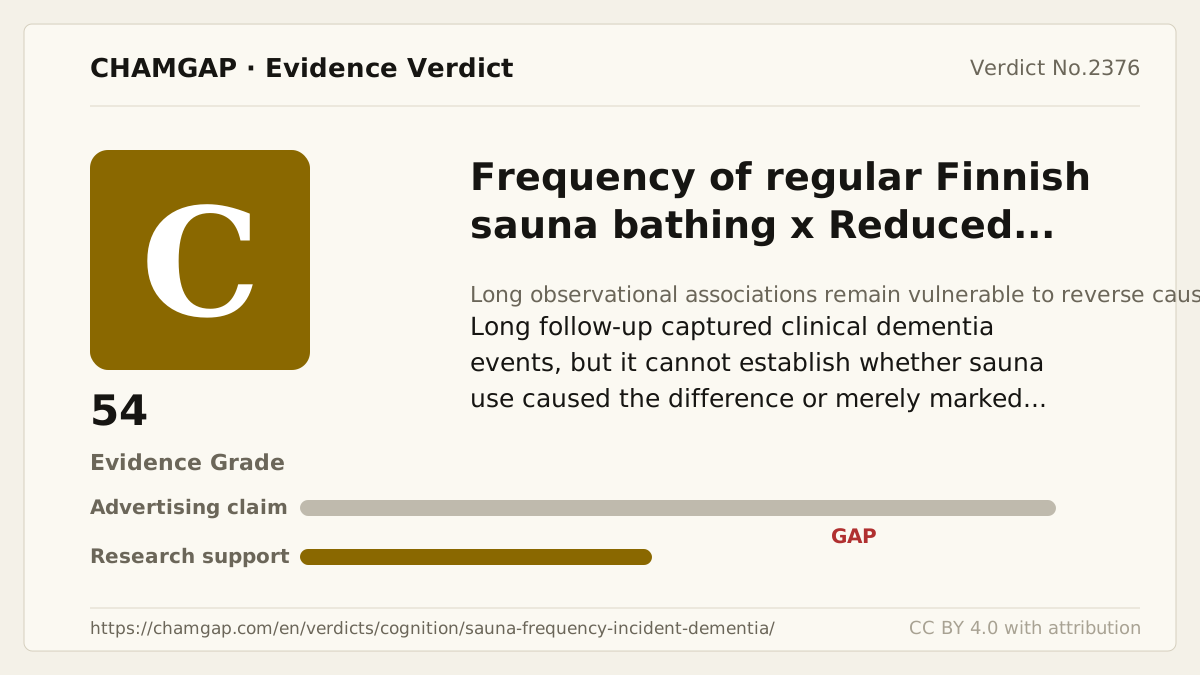
[Chamgap] Sauna-bathing frequency x reduced incident dementia — Evidence Grade C·54. 2 cited sources checked. Source: https://chamgap.com/en/verdicts/cognition/sauna-frequency-incident-dementia/ · CC BY 4.0CC BY 4.0 — free to use with attribution; do not distort grades, numbers, or verdict meaning.
What this document does and does not do
Chamgap is an information source. It reports what research has and has not confirmed; it does not tell readers what to take or buy. That decision belongs to readers and, when needed, medical or legal professionals. This verdict reflects literature available up to the search date and may change as new research appears. Nothing here is medical advice.