
Ward protocol for fever, hyperglycemia, and swallowing,
does it really help with Reducing death or dependency after acute stroke?
research showsA structured acute-stroke ward protocol for fever, hyperglycemia, and swallowing dysfunction reduced death or dependency at 90 days from 58% to 42%. The adjusted absolute difference was 15.7 percentage points, corresponding to about 6.4 patients treated per event avoided.
ads claimThe evidence applies to the complete protocol. It cannot establish that fever treatment, glucose control, or swallowing screening alone produces the same effect size.
Useful facts when choosing a product
- The intervention was not a product but a nurse-led bundle in acute stroke units.
- It combined monitoring and treatment of fever and hyperglycemia with swallowing screening and safe oral-intake management.
What the research actually shows
QASC randomized 19 Australian acute stroke units—10 intervention and 9 control—and studied pre- and post-randomization cohorts. Unit-level assignment was used to limit contamination, and analyses accounted for clustering and baseline differences. Verdict 2761 is D with 34 points and asks whether 24-hour head positioning shifts 90-day disability; this verdict asks whether a bundled fever, glucose, and swallowing ward protocol reduces death or dependency. The intervention and endpoint differ despite the shared acute-stroke setting and cluster design.
Axis 6 B0 evidence ① Allocation concealment: "De-identified stratification details were provided to an independent statistician who used random number generating software to randomise within strata with allocation concealed until provided to the Project Officer who assigned ASUs to their groups." ② Masking: "Patients were blind to ASU group allocation but not clinicians delivering our intervention. Research assistants who undertook the CATIs and the medical record audits were blind to trial aims, design and group allocation; the trial statistician was blind to group allocation." ③ Analysis population and missing data: "All analyses were done by intention to treat." Two of 1,009 post-randomization patients lacked the primary mRS outcome and were omitted from that denominator, leaving 1,007 analyzed. ④ Prespecified primary outcome: "The primary outcome was death or dependency (modified Rankin scale [mRS] ≥2) at 90 days." — consistent with registration ACTRN12608000563369
Why this is classified as B (72)
A large absolute benefit was found on the clinical composite of death or dependency, while allocation concealment, patient and assessor masking, assigned-group analysis, and prospective outcome specification were documented. The evidence remains one cluster trial and included Australian Diabetes Society–Servier-linked support, supporting grade B.
Counterpoint. Funding came from NHMRC ID 353803, St Vincent's Clinic Foundation, the Curran Foundation, Australian Diabetes Society–Servier, the College of Nursing, and Australian Catholic University. This was not a product trial and no company provision of trial materials or assessment tools was identified, but the Servier-linked contribution prevents classifying the evidence as exclusively public or nonprofit funded.
Rejudgment record. New verdict
| Endpoint | H | Hard endpoint - actual events such as death |
| Replication | R1 | Single confirmatory trial |
| Independence | I1 | Mixed funding sources |
| Effect size | E+ | Meets the clinically important threshold |
The scoring table and the verdict agree (B).
Sub-claim grades by effect
This ingredient is marketed for several effects. A single overall grade blends strong and weak claims together, so each effect is graded separately here. The overall grade reflects the strongest disconfirming or core claim.
| Effect (sub-claim) | Grade | Basis |
|---|---|---|
| The ward protocol reduces death or dependency at 90 days. | B | A large clinical difference was found: adjusted absolute difference 15.7 percentage points and NNT 6.4. |
| The ward protocol reduces 90-day mortality alone. | D | Mortality alone was 21/558 versus 24/451 without a significant difference. |
Cross-check — Codex and Claude
Evidence Table
| Study | Design | Sample | Funding | Endpoint | Result | Weight |
|---|---|---|---|---|---|---|
| QASC | Cluster-randomized controlled trial in 19 Australian acute stroke units with pre- and post-randomization cohorts | 1,696 patient records across both cohorts; 1,009 post-randomization patients; 1,007 with the 90-day primary outcome (558 intervention, 449 control) | NHMRC ID 353803, St Vincent's Clinic Foundation, the Curran Foundation, Australian Diabetes Society–Servier, the College of Nursing, and Australian Catholic University. No company provision of trial materials or assessment tools was identified. | Death or dependency at 90 days: 236/558 (42%) vs 259/449 (58%); adjusted absolute difference 15.7 percentage points (95% CI 5.8–25.4), NNT 6.4, p=.002. |
Receipt — 3 References
All 3 cited sources were verified for existence at the original page (as of 2026-08-18).
Reviewed and approved: Chamgap Editorial Team · Approval date: 2026-08-18 · Corrections: none
Cite this verdict
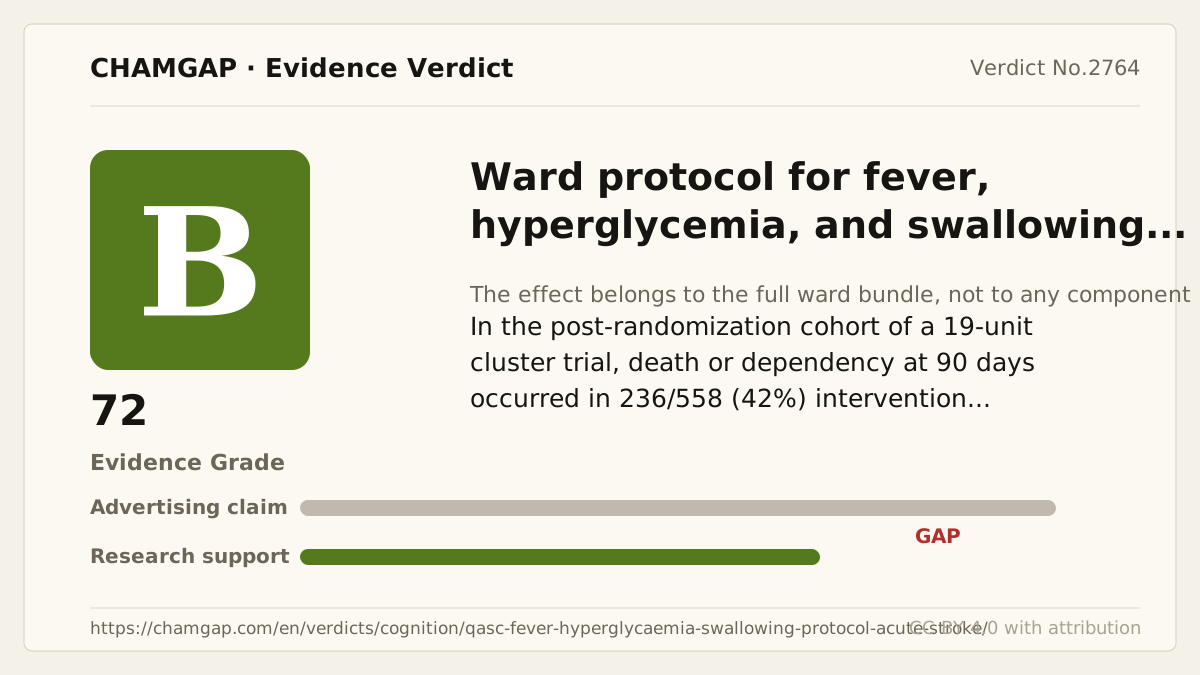
[Chamgap] Fever, hyperglycemia, and swallowing ward protocol × acute stroke — Evidence Grade B·72. 3 cited sources checked. Source: https://chamgap.com/en/verdicts/cognition/qasc-fever-hyperglycaemia-swallowing-protocol-acute-stroke/ · CC BY 4.0CC BY 4.0 — free to use with attribution; do not distort grades, numbers, or verdict meaning.
What this document does and does not do
Chamgap is an information source. It reports what research has and has not confirmed; it does not tell readers what to take or buy. That decision belongs to readers and, when needed, medical or legal professionals. This verdict reflects literature available up to the search date and may change as new research appears. Nothing here is medical advice.