
PDE5 inhibitors,
does it really help with Reduced incidence of Alzheimer disease?
research showsC. In 269,725 men with erectile dysfunction, incidence was 8.1 versus 9.7 per 10,000 person-years and adjusted HR 0.82 (0.72–0.93). Healthy-user and access-to-care confounding remain, and a three-year lag yielded HR 0.93 (0.80–1.08).
ads claimThis is not evidence to advertise PDE5 inhibitors as Alzheimer-prevention drugs.
Useful facts when choosing a product
- Active comparator: no; nonusers were the reference.
- Strict active-comparator new-user design: no.
- Negative-control outcome: no.
- Pre-diagnosis exclusion: one- and three-year lag analyses were performed; the three-year result was null.
- Verdict 629 is B with 79 points for sildenafil improving erection and intercourse success; this verdict concerns long-term Alzheimer incidence.
- No independent direct replication in the same ED population, comparison, endpoint, and timeframe was confirmed.
What the research actually shows
After exclusions, 269,725 of 413,858 men with newly diagnosed ED were analyzed. Over median 5.1 years and 1,309,205 person-years, 1,119 AD cases occurred: 749 among exposed men and 370 among nonusers. A DREAM active-comparator study in pulmonary hypertension reported null HRs, including 0.99 (0.69–1.43), but its indication and baseline incidence differed and it was not counted as direct replication.
Why this is classified as C (54)
The primary hard-event association was statistically positive, but multiple avoidable bias concerns and lack of direct replication yield C with 54 points.
Counterpoint. Causality requires randomized evidence or at least replication with an active-comparator new-user design in the same indication.
Rejudgment record. New verdict — Accepted the positive primary association while accounting for nonuser comparison, absent negative controls, and disappearance with a three-year lag
| Endpoint | H | Hard endpoint - actual events such as death |
| Replication | R1 | Single confirmatory trial |
| Independence | I1 | Mixed funding sources |
| Effect size | E+ | Meets the clinically important threshold |
The scoring table and the verdict agree (C).
Sub-claim grades by effect
This ingredient is marketed for several effects. A single overall grade blends strong and weak claims together, so each effect is graded separately here. The overall grade reflects the strongest disconfirming or core claim.
| Effect (sub-claim) | Grade | Basis |
|---|---|---|
| Reduced Alzheimer-disease incidence | C | Positive primary analysis, null three-year lag |
Cross-check — Codex and Claude
Evidence Table
| Study | Design | Sample | Funding | Endpoint | Result | Weight |
|---|---|---|---|---|---|---|
| Adesuyan et al. 2024 | Population-based retrospective cohort with nonuser comparator | 269,725 | Article processing charge funded by UCL; other relevant project funding not reported in the accessible article text | Incident Alzheimer-disease diagnosis | 8.1 versus 9.7 per 10,000 person-years; HR 0.82 (0.72–0.93); three-year lag 0.93 (0.80–1.08) | Decisive observational study |
| Desai et al. DREAM 2022 | Active-comparator new-user cohort in pulmonary hypertension | NIH DREAM program | Alzheimer disease and related dementia | Key analyses, including HR 0.99 (0.69–1.43), were null | Indirect contrary evidence in another indication |
Receipt — 2 References
All 2 cited sources were verified for existence at the original page (as of 2026-08-07).
Reviewed and approved: Chamgap Editorial Team · Approval date: 2026-08-07 · Corrections: none
Cite this verdict
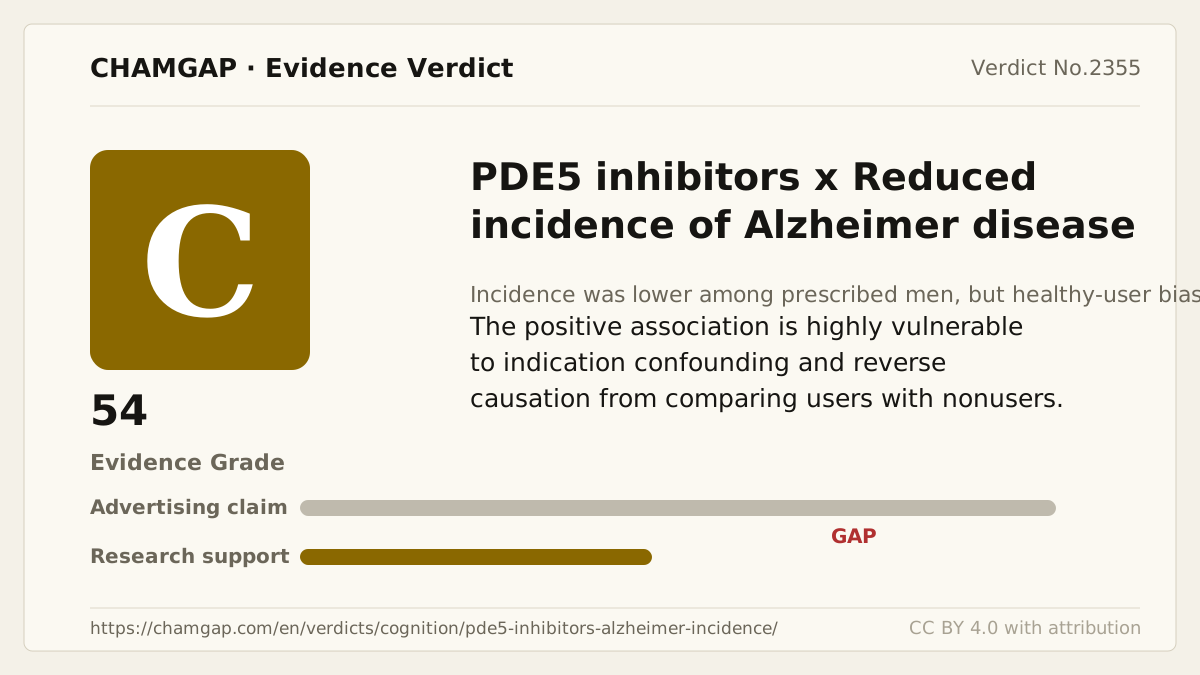
[Chamgap] PDE5 inhibitors × reduced Alzheimer-disease incidence — Evidence Grade C·54. 2 cited sources checked. Source: https://chamgap.com/en/verdicts/cognition/pde5-inhibitors-alzheimer-incidence/ · CC BY 4.0CC BY 4.0 — free to use with attribution; do not distort grades, numbers, or verdict meaning.
What this document does and does not do
Chamgap is an information source. It reports what research has and has not confirmed; it does not tell readers what to take or buy. That decision belongs to readers and, when needed, medical or legal professionals. This verdict reflects literature available up to the search date and may change as new research appears. Nothing here is medical advice.