
Patisiran,
does it really help with Improvement in the 18-month mNIS+7 neurologic impairment score in hereditary ATTR amyloidosis with polyneuropathy?
research showsThe grade is C. At 18 months in APOLLO, mNIS+7 changed by -6.0 with patisiran and +28.0 with placebo, an adjusted difference of -34.0 points (95% CI -39.9 to -28.1). The primary endpoint was a surrogate neurologic impairment score, the evidence is one manufacturer-funded trial, and 37/225 participants (16.4%) lacked the Month 18 primary assessment, giving C with 50 points.
ads claimIt is inaccurate to rewrite 'the neurologic impairment score improved' as 'walking and working ability were maintained.' In Korea, hereditary ATTR amyloidosis is ultra-rare and precise public patient counts are limited; reimbursement and access need confirmation against rare-disease registration, the authorized indication, and specialist-center criteria.
Useful facts when choosing a product
- Patisiran is an RNA-interference therapy administered by intravenous infusion every three weeks.
- All patients received oral vitamin A at the recommended daily allowance.
- Infusion-related reactions occurred in about 20% with patisiran and 10% with placebo and were mostly mild or moderate.
What the research actually shows
Across 44 sites in 19 countries, 225 patients were assigned 2:1 to patisiran 148 or placebo 77 in a double-blind phase 3 trial. The allocation sentence was, 'Patients were randomly assigned, in a 2:1 ratio, by means of the interactive response system.' Patients and personnel monitoring infusions or performing clinical assessments were blinded; unblinded drug-preparation staff had no role in management or assessment. All randomized patients receiving at least one dose were included in modified intention-to-treat mixed-model repeated-measures analyses. Defect name: Substantial attrition in the Month 18 primary assessment. Listed item: Substantial attrition (>=15%) - actual missing Month 18 mNIS+7 data were 37/225 (16.4%). Avoidability: Avoidable - final blinded assessments could have been pursued more completely after treatment discontinuation. Small study, total under 200: not applicable, actual total 225. Short study under 12 weeks: not applicable, actual duration 18 months. Alnylam Pharmaceuticals sponsored the trial, participated in protocol, analysis, and writing, and several authors were company employees.
Why this is classified as C (50)
The primary endpoint was the surrogate mNIS+7 neurologic impairment score, capping the grade at C; one manufacturer-funded trial with 16.4% missing primary assessments gives C with 50 points.
Counterpoint. Prespecified quality-of-life, 10-m gait-speed, and modified-BMI outcomes all favored patisiran, making the finding more compelling than an isolated score change, but they do not turn it into hard-outcome evidence.
Rejudgment record. Cross-check applied — Cross-checked APOLLO's 225-person double-blind allocation, 18-month mNIS+7 and prespecified secondary outcomes, missing data, and Alnylam sponsorship and employee authorship
| Endpoint | S | Surrogate marker - laboratory or imaging measures |
| Replication | R1 | Single confirmatory trial |
| Independence | I0 | Evidence comes only from manufacturer studies |
| Effect size | E+ | Meets the clinically important threshold |
The scoring table and the verdict agree (C).
Sub-claim grades by effect
This ingredient is marketed for several effects. A single overall grade blends strong and weak claims together, so each effect is graded separately here. The overall grade reflects the strongest disconfirming or core claim.
| Effect (sub-claim) | Grade | Basis |
|---|---|---|
| Improvement in the 18-month mNIS+7 neurologic impairment score | C | The adjusted difference was -34.0 points (95% CI -39.9 to -28.1). |
| Long-term preservation of walking, employment, and independent living | ? | Gait speed and quality of life improved, but these long-term life outcomes were not directly tested. |
Cross-check — Codex and Claude
Evidence Table
| Study | Design | Sample | Funding | Endpoint | Result | Weight |
|---|---|---|---|---|---|---|
| Study 1 | Multinational randomized double-blind placebo-controlled phase 3 trial | 188 | Sponsored by Alnylam Pharmaceuticals, which participated in design, analysis, and writing; employee authors included | Change in mNIS+7 at 18 months | -6.0 versus +28.0 points, adjusted difference -34.0 (95% CI -39.9 to -28.1), P<0.001 | Large double-blind trial for a rare disease, but surrogate and manufacturer-only evidence |
Receipt — 1 References
All 1 cited sources were verified for existence at the original page (as of 2026-08-18).
Reviewed and approved: Chamgap Editorial Team · Approval date: 2026-08-18 · Corrections: none
Cite this verdict
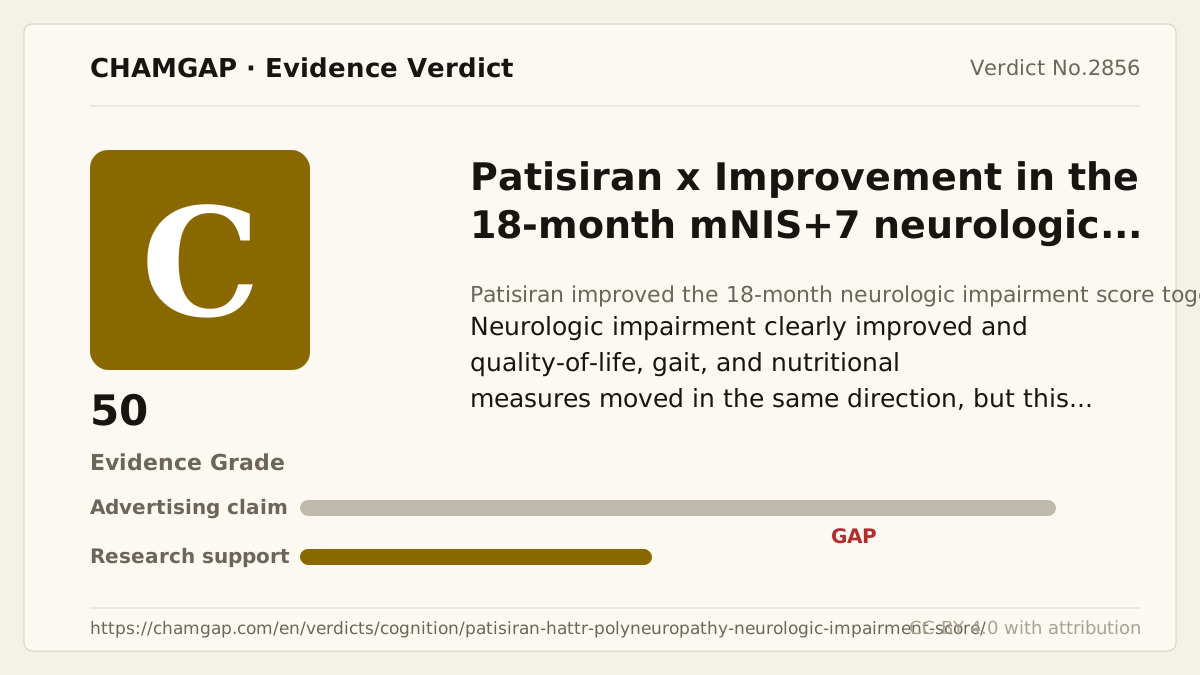
[Chamgap] Patisiran Benefits the Neurologic Impairment Score in Hereditary ATTR Amyloidosis with Polyneuropathy — Evidence Grade C·50. 1 cited sources checked. Source: https://chamgap.com/en/verdicts/cognition/patisiran-hattr-polyneuropathy-neurologic-impairment-score/ · CC BY 4.0CC BY 4.0 — free to use with attribution; do not distort grades, numbers, or verdict meaning.
What this document does and does not do
Chamgap is an information source. It reports what research has and has not confirmed; it does not tell readers what to take or buy. That decision belongs to readers and, when needed, medical or legal professionals. This verdict reflects literature available up to the search date and may change as new research appears. Nothing here is medical advice.