
Mobile stroke unit,
does it really help with Reduced disability and increased functional independence at 90 days?
research showsThe grade is C. In the 1,047 t-PA-eligible BEST-MSU analysis, mean 90-day utility-weighted mRS was 0.72 with mobile-unit care and 0.66 with conventional EMS, while favorable function corresponding to mRS 0 to 1 was 55.0% versus 44.4%. However, patients were assigned through prespecified alternating weeks rather than individual randomization, and enrollment was heavily concentrated in Houston, limiting causal certainty despite the large difference.
ads claimThe result does not mean that purchasing a CT-equipped ambulance alone recreates the benefit. The intervention bundled specialist staffing, telemedicine or onboard neurology, point-of-care testing, t-PA protocols, and hospital integration.
Useful facts when choosing a product
- The mobile unit bundled CT, point-of-care testing, paramedic and critical-care nursing staff, neurologic decision-making, and intravenous t-PA.
- Assignment alternated designated mobile-unit and conventional-EMS weeks at each site rather than randomizing individual patients.
- Genentech supplied t-PA at no cost but had no role in design, conduct, analysis, or reporting; primary study funding came from PCORI.
What the research actually shows
BEST-MSU prospectively alternated designated mobile-unit and conventional-EMS weeks across seven cities. A total of 1,515 patients were enrolled; 617 versus 430 judged t-PA eligible by later blinded review entered the primary analysis. Median onset-to-t-PA time was 72 versus 108 minutes. The study used common clinical criteria plus blinded eligibility and 90-day assessment, but not patient-level randomization. The primary outcome in NCT02190500 matched the paper.
Why this is classified as C (54)
A publicly funded prospective study found better blinded 90-day function and a large absolute difference in independence, but nonrandom assignment and Houston-centered enrollment give C with 54 points.
Counterpoint. The effect belongs to a highly organized urban system. Effectiveness and cost-effectiveness need separate testing in rural areas and systems with different hours, staffing, and hospital networks.
Rejudgment record. Cross-check applied — A publicly funded prospective study found a large difference in blinded 90-day function, with patient-level nonrandom assignment and one-city enrollment concentration reflected
| Endpoint | P | Patient-reported treatment goal - the symptom is the goal |
| Replication | R1 | Single confirmatory trial |
| Independence | I2 | Decisive evidence is publicly or non-profit funded |
| Effect size | E+ | Meets the clinically important threshold |
The scoring table and the verdict agree (C).
Sub-claim grades by effect
This ingredient is marketed for several effects. A single overall grade blends strong and weak claims together, so each effect is graded separately here. The overall grade reflects the strongest disconfirming or core claim.
| Effect (sub-claim) | Grade | Basis |
|---|---|---|
| Increased functional independence at 90 days | C | mRS 0 to 1 was 55.0% versus 44.4%, but patients were not individually randomized. |
| Shorter onset-to-thrombolysis time | C | Median time was 72 versus 108 minutes. |
Cross-check — Codex and Claude
Evidence Table
| Study | Design | Sample | Funding | Endpoint | Result | Weight |
|---|---|---|---|---|---|---|
| Study 1 | Prospective seven-city alternating-week nonrandomized controlled trial | 430 | Public PCORI funding; t-PA and some study medication supplied at no cost | Blinded 90-day utility-weighted modified Rankin Scale | Mean 0.72 versus 0.66; mRS 0 to 1 was 55.0% versus 44.4%, adjusted OR 2.43 (95% CI 1.75 to 3.36), P<0.001. | Pivotal but nonrandomized prospective evidence |
Receipt — 1 References
All 1 cited sources were verified for existence at the original page (as of 2026-08-15).
Reviewed and approved: Chamgap Editorial Team · Approval date: 2026-08-15 · Corrections: none
Cite this verdict
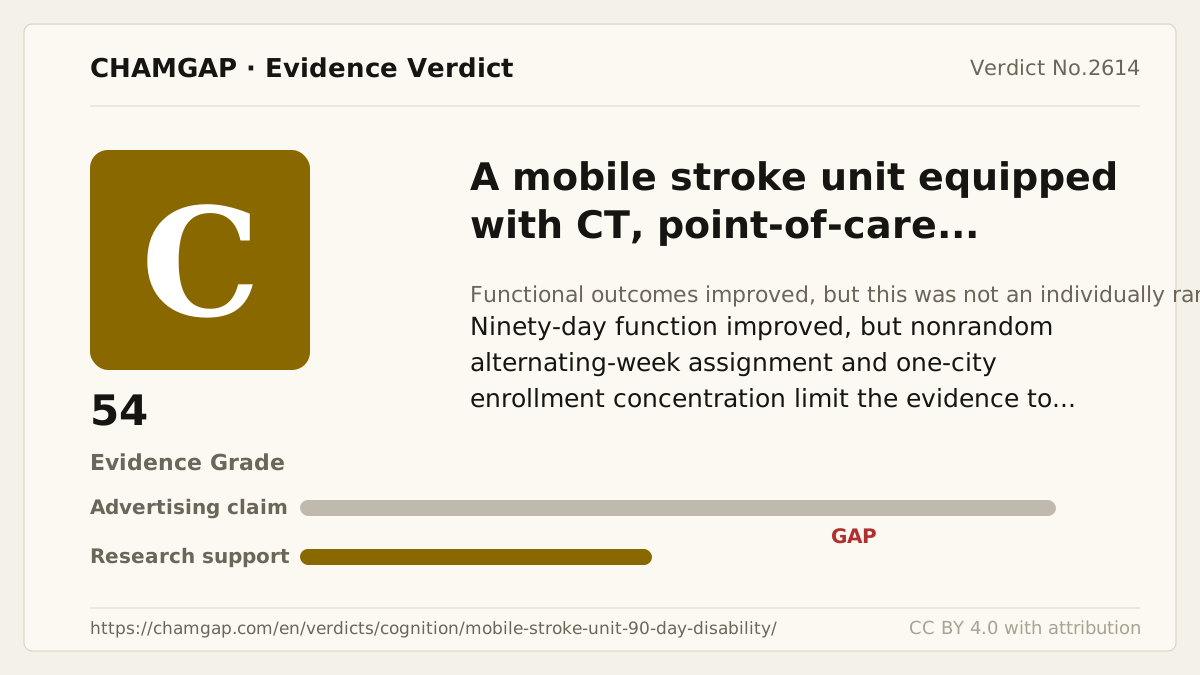
[Chamgap] Mobile stroke unit x 90-day disability — Evidence Grade C·54. 1 cited sources checked. Source: https://chamgap.com/en/verdicts/cognition/mobile-stroke-unit-90-day-disability/ · CC BY 4.0CC BY 4.0 — free to use with attribution; do not distort grades, numbers, or verdict meaning.
What this document does and does not do
Chamgap is an information source. It reports what research has and has not confirmed; it does not tell readers what to take or buy. That decision belongs to readers and, when needed, medical or legal professionals. This verdict reflects literature available up to the search date and may change as new research appears. Nothing here is medical advice.