
Twenty-four-hour lying-flat head position,
does it really help with Reduced 90-day disability versus sitting up at 30 degrees or more?
research showsThe grade is D with 34 points. HeadPoST cluster-randomized 11,093 patients across 114 hospitals in a crossover design. Among 9,748 patients with the 90-day modified Rankin outcome, the common odds ratio was 1.01 (95% CI 0.92 to 1.10; P=.84). Lying flat did not improve the disability distribution, and mortality was 7.3% versus 7.4%.
ads claimA physiologic statement that lying flat may alter cerebral blood flow must not be expanded into improved 90-day function. The large clinical trial found no difference in disability, death, or pneumonia between the standardized positions.
Useful facts when choosing a product
- The intervention was a 0-degree lying-flat position for at least 24 hours early after admission.
- The comparator elevated the head to at least 30 degrees.
- NCT02162017 and ACTRN12614000483651 are two registrations of the same trial.
What the research actually shows
A total of 5,295 patients were assigned to lying flat and 5,798 to sitting up; 90-day mRS data were available for 4,676 and 5,072, respectively. Serious adverse events occurred in 756/5,295 (14.3%) versus 784/5,798 (13.5%), and pneumonia in 164/5,295 (3.1%) versus 198/5,798 (3.4%). NHMRC grant 1066966 funded the trial. Author disclosures listed advisory, lecture, and travel relationships with Medtronic, AstraZeneca, Takeda, Boehringer Ingelheim, and others, but did not state that a company supplied a positioning intervention or an assessment tool used in this trial. Axis 6 B0 evidence ① Allocation concealment: "A statistician not otherwise involved in the trial will generate the randomised allocation sequence ... and the allocation sequence will be concealed until the interventions are assigned." ② Masking: "cluster-randomized, crossover, open-label trial with blinded outcome evaluation" — positioning could not be masked, while outcome evaluation was masked. ③ Analysis population and missing data: "We will analyse patients in the treatment group to which they are allocated according to the intention-to-treat principle." Multiple-imputation sensitivity analysis addressed missing 90-day outcomes. ④ Prespecified primary endpoint: "The primary outcome of death or disability according to the mRS score at 90 days" — consistent with registrations NCT02162017 and ACTRN12614000483651
Why this is classified as D (34)
The large publicly funded cluster trial used masked outcome evaluation and missing-data sensitivity analysis, but benefit on 90-day disability was null and only one confirmatory trial exists, giving D with 34 points.
Counterpoint. D does not deny that one position may be more comfortable or appropriate for an individual patient's aspiration or respiratory risk. It applies to the claim that the standardized 24-hour strategy improves overall 90-day disability.
Rejudgment record. Cross-check applied — Cross-checked the HeadPoST article, protocol, and both registrations for the cluster-crossover design, 90-day mRS, analyzed population, missing-data sensitivity analysis, NHMRC funding, and author disclosures
| Endpoint | P | Patient-reported treatment goal - the symptom is the goal |
| Replication | R1 | Single confirmatory trial |
| Independence | I2 | Decisive evidence is publicly or non-profit funded |
| Effect size | E0 | Null |
| Precision | C0 | The confidence interval leaves room for benefit |
The scoring table and the verdict agree (D).
Sub-claim grades by effect
This ingredient is marketed for several effects. A single overall grade blends strong and weak claims together, so each effect is graded separately here. The overall grade reflects the strongest disconfirming or core claim.
| Effect (sub-claim) | Grade | Basis |
|---|---|---|
| Improved 90-day disability distribution | D | The common OR was null at 1.01 (0.92 to 1.10). |
| Reduced 90-day mortality | D | Mortality was 7.3% versus 7.4%. |
Cross-check — Codex and Claude
Evidence Table
| Study | Design | Sample | Funding | Endpoint | Result | Weight |
|---|---|---|---|---|---|---|
| Study 1 | International 114-hospital cluster-randomized crossover open-intervention trial with masked outcome evaluation | 5,072 | Australian NHMRC grant 1066966; no statement of company-supplied trial materials or assessment tools | Distribution of modified Rankin disability scores at 90 days | Common OR 1.01 (95% CI 0.92 to 1.10), P=.84; mortality 7.3% versus 7.4% | Null result from one large publicly funded confirmatory trial |
Receipt — 1 References
All 1 cited sources were verified for existence at the original page (as of 2026-08-18).
Reviewed and approved: Chamgap Editorial Team · Approval date: 2026-08-18 · Corrections: none
Cite this verdict
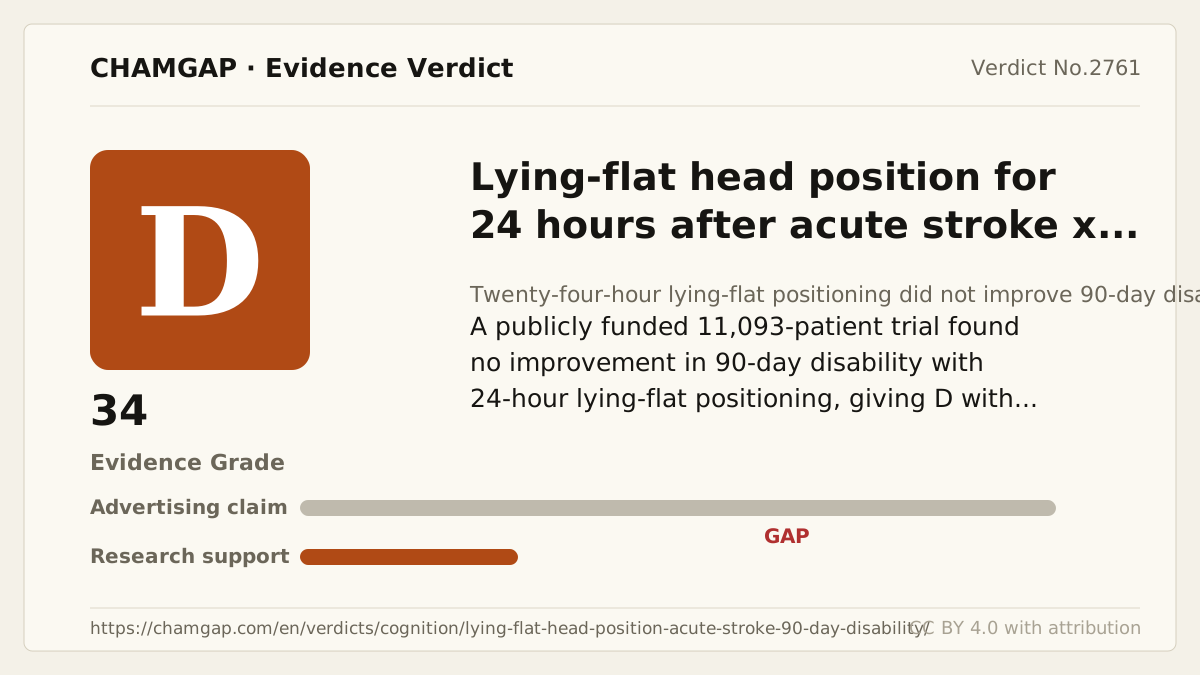
[Chamgap] Twenty-four-hour lying-flat head position x 90-day disability after acute stroke — Evidence Grade D·34. 1 cited sources checked. Source: https://chamgap.com/en/verdicts/cognition/lying-flat-head-position-acute-stroke-90-day-disability/ · CC BY 4.0CC BY 4.0 — free to use with attribution; do not distort grades, numbers, or verdict meaning.
What this document does and does not do
Chamgap is an information source. It reports what research has and has not confirmed; it does not tell readers what to take or buy. That decision belongs to readers and, when needed, medical or legal professionals. This verdict reflects literature available up to the search date and may change as new research appears. Nothing here is medical advice.